

The Economic Community of West African States (Economic Community of West African States) has unveiled its survival strategy aimed at rebuilding the bloc to effectively respond to emerging challenges in the subregion.
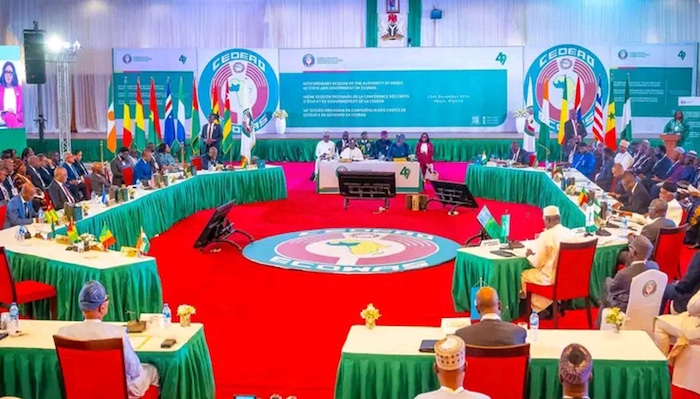
The proposal was presented at the ongoing First Ordinary Session of the ECOWAS Parliament in Abuja by ECOWAS Commissioner for Political Affairs, Peace and Security, Ambassador Abdel-Fatau Musah.
Musah said the Compact which repreensts a shift is designed to operationalise ECOWAS Vision 2050, aimed at transforming body to an “ECOWAS of the Peoples.”
According to him, the initiative acknowledges that the regional body is at its most fragile point since its establishment in 1975, due largely to governance failures, democratic setbacks and the emergence of alternative alliances such as the Alliance of Sahel States (AES), comprising Burkina Faso, Mali and Niger.
He explained that the initiative stems from a directive issued by the ECOWAS Authority of Heads of State and Government during its 65th Ordinary Session held in Abuja on July 7, 2024, which called for a Special Summit on the future of regional integration in West Africa.
The proposed Compact is built around six strategic pillars, including sustainable economic transformation, peace and democratic governance, science and technology, social inclusion, institutional reform, and ECOWAS geopolitical positioning.
Under the economic transformation pillar, ECOWAS aims to double intra-regional trade to 30 per cent by 2035, promote industrialisation and food sovereignty, and implement the ECO single currency by 2040.
On governance and security, the document reaffirms zero tolerance for military coups and unconstitutional manipulation of civilian constitutions, while proposing a stronger ECOWAS Standby Force to address emerging threats.
The science and technology pillar envisions the establishment of a Digital Single Market by 2030, while the social inclusion component seeks to raise women’s representation in leadership to 40 per cent and institutionalise youth participation in governance.
The Compact also proposes reforms to make ECOWAS institutions more merit-based, accountable and fully self-financed through the Community Levy by 2030.
A major feature of the document is its emphasis on “strategic autonomy,” positioning ECOWAS as a unified geopolitical actor capable of defending West Africa’s sovereignty in an increasingly multipolar world.
The proposal further outlines a framework for structured dialogue and confidence-building measures with the AES countries to prevent permanent fragmentation of the region.
The Nation