


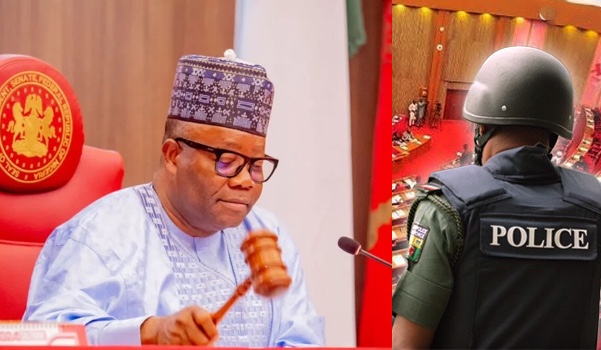
The Nigerian Senate has passed the constitutional amendment establishing state police services across the country, ending decades of debate over the decentralisation of policing with a vote that, in a fitting reflection of the country’s infrastructure challenges, had to be conducted by hand after the chamber’s electronic voting system failed.
The bill, formally titled the Sixth Alteration Bill 2026, passed through second reading, clause-by-clause consideration, and third reading during Wednesday’s emergency session in Abuja, presided over by Senate President Godswill Akpabio. Senate Leader Opeyemi Bamidele presented the bill’s general principles before it moved through each legislative stage.
The substance of what passed is significant. Nigeria’s existing policing structure, built around a single centralised Nigeria Police Force, will be replaced by a dual arrangement comprising a Federal Police Service and state police services operating in parallel. The federal service retains responsibility for federal offences, national security matters, interstate crime, and law enforcement within the Federal Capital Territory. State services will handle local law enforcement, public order, and the protection of lives and property within their respective states.
The bill creates constitutional provisions for state police commissions to govern appointment, oversight, discipline, and removal of state police commanders. It also retains the federal police structure within each state until a state service becomes operational, ensuring no security gap during the transition. Federal intervention in state police operations remains possible under circumstances such as a breakdown of public order, operational incapacity, or a threat to national security.
President Bola Tinubu had transmitted the bill to the Senate as part of a broader security sector reform agenda, framing the dual policing structure as a necessary legal foundation for more responsive local law enforcement.
The vote itself became an unexpected subplot. Electronic voting devices failed to activate despite more than thirty minutes of attempts. Senate Leader Bamidele moved a motion to proceed manually, seconded by Minority Leader Abba Moro of the PDP, and senators voted by raising their hands. That a constitutional amendment of this magnitude was ultimately decided by a show of hands in a chamber whose electronic voting infrastructure could not function is a detail the Senate may prefer to footnote. It is also, in its own way, entirely Nigerian.
The bill now moves to the House of Representatives for harmonisation before heading to the 36 State Houses of Assembly for ratification. Two-thirds of state assemblies must approve it before it becomes part of the constitution. The Senate has done its part. The longer process is still ahead.