

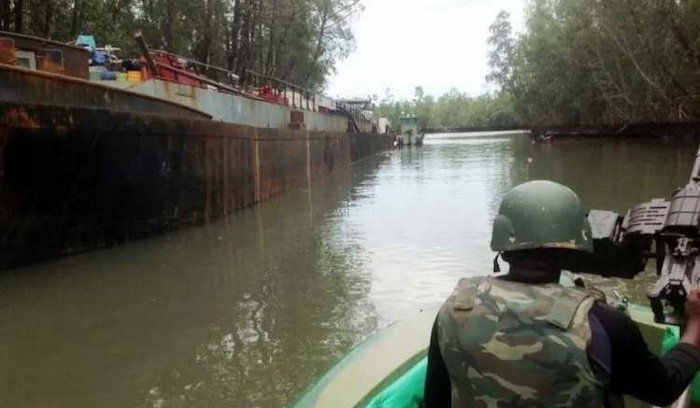
Nigerian Navy personnel have intercepted over 22,000 litres of illegally refined diesel from a network of concealed stockpiles in the Orashi Forest area of Rivers State, in an intelligence-led operation that combined waterway patrols with drone surveillance to locate products hidden under vegetation and inside ponds.
The operation, conducted under Operation DELTA SENTINEL by personnel from Nigerian Navy Ship SOROH, targeted the Okolomade Community in Abua/Odual Local Government Area, an area bordering Bayelsa State’s Ogbia Local Government Area. Director of Naval Information Captain Abiodun Folorunsho confirmed the details in a statement issued Sunday from Abuja.
The operation began when a patrol team acting on credible intelligence intercepted a wooden boat carrying 36 sacks of suspected illegally refined Automotive Gas Oil along a creek channel. Rather than treating the interception as a standalone find, the team deployed a drone to conduct aerial surveillance of the surrounding area. The footage identified additional stockpiles that ground-level search alone would not have located, concealed at multiple points within the vegetation and waterlogged terrain.
A detailed search that followed recovered an additional 45 sacks from different locations, bringing the total to 81 sacks containing approximately 22,870 litres. The wooden boat used to transport the products was also seized and will be denied to the criminal network that operated it.
Both the recovered petroleum products and the vessel were processed in line with anti-crude oil theft procedures. Folorunsho described the outcome as a disruption to the logistics network supporting illegal refining in the Niger Delta, a network that relies on the region’s creek geography to move products through routes that are difficult to monitor without aerial support.
The use of drone surveillance as an intelligence exploitation tool rather than a primary search method is particularly innovative. The boat interception provided the initial lead. The drone converted that lead into a more comprehensive operation. That sequencing reflects an approach to creek-based enforcement that accounts for the limitations of surface patrols in terrain designed, by geography and by the people who know it, to conceal movement.
Illegal refining and petroleum product theft remain among the most significant sources of revenue loss in Nigeria’s energy sector and among the most persistent security challenges in the Niger Delta. Single seizures of this scale do not dismantle networks. They do, however, impose costs, disrupt logistics, and demonstrate that the waterways are not as unmonitored as criminal operators may have assumed.