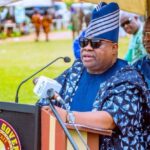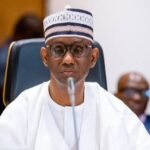


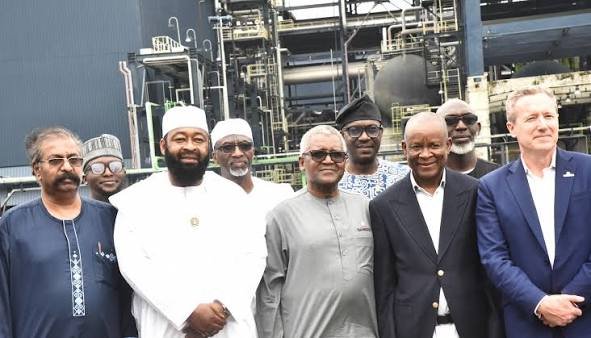
A high-profile tour of Aliko Dangote’s industrial empire in Lagos turned into a showcase of mutual praise this week, as Minister of State for Industry John Enoh credited the businessman with anchoring Nigeria’s industrial ambitions, while Dangote pushed back with equally warm words about the minister’s commitment to the sector.
Leading a delegation through the 700,000 barrels-per-day Dangote Petroleum Refinery, the Dangote Petrochemicals complex, and Dangote Fertiliser Limited, Enoh didn’t hold back in describing the man behind the operations. “He is Nigeria’s champion. I mean, it’s even understated when they call him Africa’s wealthiest man,” he said, crediting Dangote’s presence at the February launch of the Nigeria Industrial Policy with giving the initiative the visibility it has since carried.
That policy sits at the center of Enoh’s broader agenda for the ministry, which he says has already cleared its first 90-day implementation benchmark. The targets attached to it are ambitious: raising manufacturing’s contribution to GDP to roughly 20 per cent by 2030 and 25 per cent by 2035, goals Enoh linked directly to continued investment from Dangote’s businesses rather than treating them as separate tracks. He also confirmed that talks remain ongoing around a naira-for-crude arrangement involving the refinery, expressing optimism that the negotiations would reach a favourable conclusion.
Beyond the praise, the visit produced concrete asks. Enoh said his ministry would formally present Dangote with a three-point request centered on industrial training and skills development, including support for training an estimated 65,000 additional personnel needed for the refinery’s next expansion phase, alongside efforts to build out downstream value chains around the petrochemicals complex and deepen collaboration on free trade zone projects, including the one recently commissioned in Ondo State. Enoh also singled out the refinery’s level of automation for praise, noting that human presence on site has largely been reduced to security personnel.
Dangote, for his part, returned the compliment with equal enthusiasm, directing his appreciation toward President Bola Tinubu for the choice of minister overseeing the sector. “I must also thank His Excellency, Mr President, for appointing people like Senator Enoh. We’ve had a lot of ministers of industry, but the commitment that we have from him, I can tell you, is none compared to the rest. His commitment is absolute,” he said.
The industrialist also used the moment to align his own ambitions with the government’s broader economic vision, backing Tinubu’s target of building Nigeria into a $1 trillion economy and positioning his conglomerate’s growth plans as a direct contribution toward that goal. “The vision of Mr President Bola Ahmed Tinubu, a $1 trillion economy, I think is more than achievable. That’s why we took out from that vision of $1 trillion to carve our own vision, we have seen that, yes, we can do $100 billion out of that $1 trillion,” Dangote said.
Ezeana Emmanuel
CRFFN Says Foreign Dominance in Freight Forwarding Reflects Deeper Structural Gaps, Not Just Nationality
Nigeria’s ongoing debate over foreign firms crowding into freight forwarding, customs brokerage, and logistics is missing the point, according to the Council for the Regulation of Freight Forwarding in Nigeria, which argues the real story isn’t about nationality at all but about long-neglected weaknesses in the country’s own industry foundations.
CRFFN Registrar Kingsley Igwe acknowledged that the growing presence of foreign operators deserves serious policy attention, but pushed back against framing the issue as a simple contest between foreign and indigenous players. In his view, that framing obscures the more important question of why foreign firms have found it easier to compete in the first place, a gap he attributes to structural and institutional shortcomings that have built up over decades rather than any inherent disadvantage tied to nationality.
Chief among those shortcomings, Igwe said, is a persistent shortage of professional capacity within the sector. He pointed to weak institutional training, inconsistent regulatory enforcement, and chronically low investment in human capital as long-standing problems that have quietly eroded the competitiveness of indigenous freight forwarders. The contrast with other countries, he noted, is instructive: many nations have deliberately built globally competitive logistics professionals through structured certification systems and continuous capacity development, an approach Nigeria has never sustained consistently enough to keep its own operators on equal footing.
Capital constraints compound the problem further, according to Igwe. Modern logistics has moved well beyond simple cargo handling into a technology-driven, capital-intensive business, one that now demands investment in digital infrastructure, multimodal transport systems, warehousing, project cargo management, and integrated supply chains, areas where underfunded indigenous operators frequently struggle to keep pace.
That capital shortfall isn’t purely a matter of scarcity, according to Dera Nnadi, a retired Deputy Comptroller-General of the Nigeria Customs Service and trade and maritime customs consultant, who backed Igwe’s assessment while adding a pointed observation of his own. Nnadi argued that many indigenous operators bear some responsibility for their own underinvestment, noting a pattern in which profits generated from freight forwarding businesses often get redirected into ventures entirely outside the maritime sector, rather than being reinvested to expand operations, strengthen capacity, and build long-term competitiveness within the industry itself.