


Digital financial services across Nigeria and beyond may be expanding at record speed, but public trust in the system underpinning them is struggling to keep up, a gap the Bridgforte Centre for Global Impact is now attempting to close with a new governance framework and a dedicated research initiative called the Trust Lab.
The announcement came at the unveiling of Bridgforte’s flagship policy report, “Trust Architecture in Platform-Led Finance,” presented during a global online dialogue that drew more than 400 participants, including central bankers, regulators, fintech executives, consumer advocates, researchers, and development partners.
Speaking at the launch, Bridgforte founder and former Central Bank of Nigeria Deputy Governor Aishah Ahmad framed the moment as a turning point in how financial inclusion needs to be approached going forward. In her view, simply expanding access to digital financial tools is no longer enough; building genuine confidence across the entire ecosystem now matters just as much. “Customers do not experience individual institutions. They experience the financial system as a whole, and in increasingly interconnected financial systems, trust is built or broken in the handoffs between institutions. Trust is not a communications exercise. It is a governance outcome, and it must be deliberately designed,” she said.
That confidence gap isn’t just theoretical. Data from the report shows financial sector leaders who participated in Bridgforte’s Executive Table session in Lagos this past February rated the resilience of trust in Nigeria’s platform-led financial ecosystem at just 5.4 out of 10. Participants at this week’s global launch arrived independently at a similar figure, 5.7 out of 10, a convergence that Bridgforte says points to a broader pattern: digital finance has simply grown faster than the public’s confidence in it has been able to follow.
South African Reserve Bank Deputy Governor Nomfundo Tshazibana reinforced that theme in her keynote address, describing trust and confidence not as soft, intangible qualities but as genuine “economic infrastructure.” She argued that resilient financial systems ultimately depend on credible institutions, sound governance, effective collaboration, and public confidence that has to be continually re-earned rather than assumed.
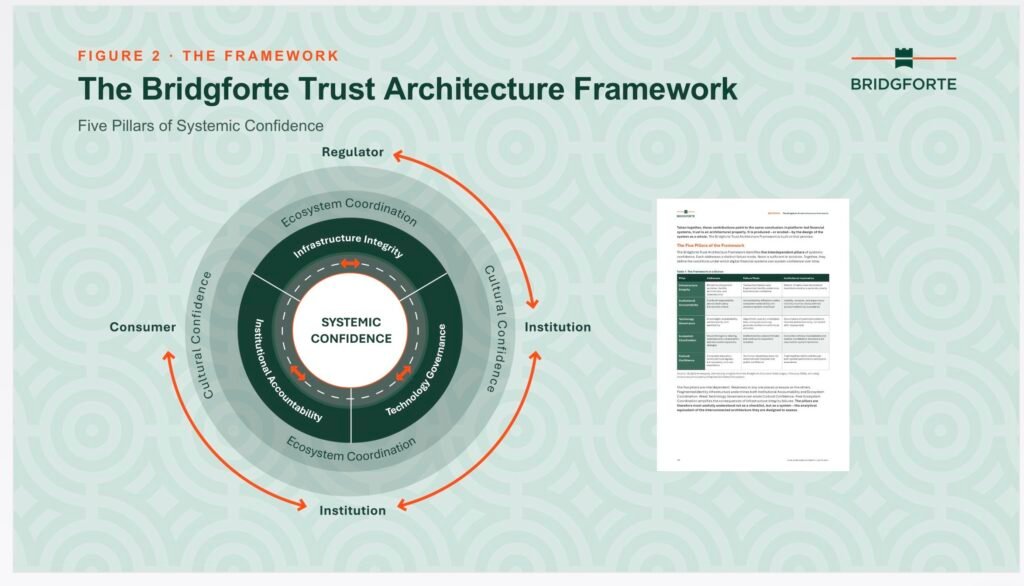
To address the gap directly, Bridgforte unveiled its Trust Architecture Framework, structured around five pillars: Infrastructure Integrity, Institutional Accountability, Technology Governance, Ecosystem Coordination, and Cultural Confidence. Alongside the framework, Ahmad announced the creation of the Trust Lab, describing it as a long-term platform dedicated to research, dialogue, and measurement, designed to give policymakers and industry leaders the tools needed to strengthen confidence as digital financial systems grow increasingly interconnected.