

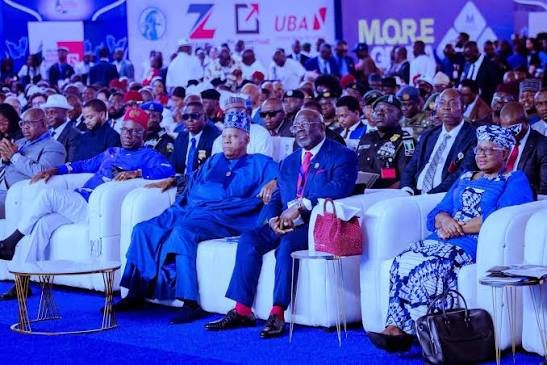
A gathering of some of the biggest names in African economic policy and business descended on Asaba this week, as Delta State used its Economic and Investment Summit to make a concentrated pitch for global capital, backed by a freshly announced $100 million fund designed to make that pitch harder to ignore.
Vice President Kashim Shettima set the tone for the summit, framing Nigeria’s 36 states as competitors in a race worth encouraging rather than avoiding. “Every state in the federation is defined by the quality and ambition of the investment promise it offers. While each state pursues prosperity, every one does so uniquely, shaped by its history, geography, people and comparative advantage. This is the race we must welcome, a race that proclaims growth over conflict; a race in which the prize is employment, prosperity and human dignity; a race for the future,” he said. Shettima argued that Delta’s real advantage extends well beyond its oil reserves, pointing to the state’s coastline, gas resources, ports, and agricultural potential as the foundation for genuine diversification. “The future of a people cannot be dependent on a single commodity. Diversification is not merely an economic strategy; it is an instinct for economic preservation and a measure of the quality of leadership,” he said.
The centerpiece announcement came from Governor Sheriff Oborevwori, who confirmed the state has set aside $100 million, roughly N137.8 billion, as a Viability Gap Fund intended to de-risk private sector investment and speed up execution of deals struck at the summit. “This is a practical demonstration of our total commitment to ensuring that the agreements reached at this summit are executed without delay,” he said, pushing back on any suggestion that the gathering was purely ceremonial. “This summit is not a talk show; we are matching words with action.”
That fund drew immediate praise from WTO Director-General Ngozi Okonjo-Iweala, who went further still, suggesting Delta has what it takes to become Nigeria’s next major industrial center alongside Lagos. “I am convinced that Delta possesses the ingredients to become Nigeria’s next great industrial hub, standing alongside Lagos as an engine of the national economy,” she said, crediting the state’s willingness to act as the reason for her attendance. “The reason I came is because you take action. The fund you have just announced to de-risk investment is exactly the kind of thing that we need.” She pointed to shifting global trade patterns as a genuine opportunity for Delta specifically, one that didn’t exist a decade ago, and urged the state to build its industrial strategy around Special Economic Zones.
Kenyan scholar Patrick Lumumba brought a continental lens to the discussion, using his remarks to press the Federal Government on a different kind of barrier entirely: visa restrictions limiting movement across Africa. “I look forward to the day when an investor from Ethiopia can board a plane and arrive in Asaba without visas, landing cards or exit cards,” he said, drawing a comparison to how freely people move across Europe. “We cannot build a competitive economy while remaining so fragmented.” Lumumba also challenged Nigerians to look past foreign capital as the default source of investment, urging African investors themselves to show up at future editions of the summit, and pointed to Norway’s management of its oil wealth as a model Delta should study closely.
Anambra Governor Chukwuma Soludo used his platform to propose a more localized partnership, describing Delta and Anambra as natural “twin growth hubs” now more closely linked than ever following completion of the Second Niger Bridge. “Delta and Anambra have effectively become twin states, much like New York and New Jersey. We should institutionalise our relationship beyond personal friendships by creating working groups that will promote economic cooperation,” he said, while urging summit organizers generally to prioritize closing real business deals over delivering speeches.
Heirs Holdings Chairman Tony Elumelu added his own endorsement of the state’s investment climate, framing the visible transformation underway as a genuine confidence builder for investors, and called specifically for a partnership with the state government to help unlock Delta’s power sector potential.
Rounding out the summit’s economic vision, Seplat Energy founding chairman and summit chair Austin Avuru laid out a detailed roadmap centered on dredging Delta’s ports at Warri and Burutu, establishing roughly 30,000 hectares of land banks to support commercial agriculture, and building on existing industrial parks in Kwale and Koko to attract manufacturing investment, arguing that the state’s second term in office needs to focus on converting infrastructure already built into tangible economic returns.