

Football is often described as the world’s most popular sport, a game governed by rules that apply equally to every player, every team and every nation.
Whether played on the streets of Lagos, the stadiums of Europe or the grand stage of the FIFA World Cup, the principle is simple: fair play.
But what happens when politics enters the pitch?
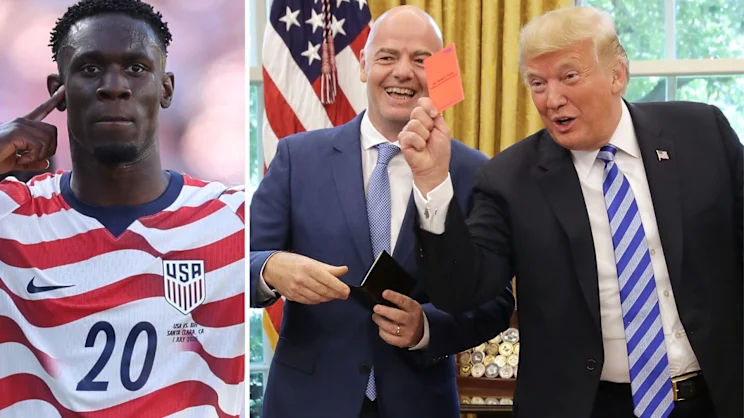
That question has come into sharp focus following the controversy surrounding United States striker Folarin Balogun, FIFA and U.S. President Donald Trump.
The incident has sparked debate far beyond football, raising concerns about influence, fairness and the independence of international sporting institutions.
At the centre of the controversy is the decision by FIFA to review disciplinary action taken against Balogun after intervention by President Trump, who later acknowledged contacting FIFA President Gianni Infantino regarding the matter.
While Trump maintained that he merely requested a review of what he considered an unfair decision, critics argue that the episode raises difficult questions about whether political influence should have any role in sporting decisions.
For many observers, the issue is no longer about a single player or a single match.
It is about whether sporting institutions can remain independent in a world where politics and sport increasingly intersect.
The credibility of football depends largely on trust.
Players trust referees to apply the rules fairly.
Teams trust governing bodies to enforce regulations consistently.
Fans trust that results are determined by performance on the field rather than influence behind closed doors.
This trust is what gives sporting competitions legitimacy.
Without it, confidence in the game begins to erode.
That is why disciplinary decisions, whether involving yellow cards, red cards or player suspensions, are usually expected to follow established procedures rather than political intervention.
When exceptions appear to occur, questions naturally follow.
The relationship between politics and sport is not new.
Throughout history, governments have used sports as tools of diplomacy, national pride and international influence.
The Olympic Games have experienced political boycotts.
Countries have been banned from competitions because of political conflicts.
Apartheid-era South Africa was excluded from many international sporting events due to global opposition to racial segregation.
More recently, sporting organisations have faced pressure over issues ranging from human rights concerns to geopolitical disputes.
These examples demonstrate that sport and politics have never been completely separate.
However, many sporting bodies insist that disciplinary decisions should remain independent and free from political influence.
What makes the current controversy different is the perception that a political leader may have influenced a decision involving a specific player.
Whether or not that perception reflects reality, it has generated debate because public confidence in institutions often depends as much on appearance as on process.
Critics argue that if powerful political figures can successfully seek reviews of sporting decisions, questions arise about equal treatment.
Would the same level of attention be given to a player from a less influential country?
Would a smaller football federation receive the same access?
These are some of the questions that have emerged since the controversy began.
Supporters of Trump’s actions, however, argue that requesting a review is not the same as directing an outcome.
They maintain that if an athlete has been treated unfairly, seeking clarification or reconsideration should not automatically be viewed as interference.
For FIFA, the controversy has once again placed the organisation under scrutiny.
As the governing body of world football, FIFA is expected to maintain neutrality and ensure that decisions are made according to established regulations.
The organisation’s credibility depends heavily on public confidence in its independence.
Whenever decisions appear to be influenced by external pressure, questions about transparency and governance are likely to follow.
This is particularly important at a time when global football attracts billions of viewers and generates enormous economic and political interest.
The significance of this debate extends beyond sports.
It reflects a broader question about institutions and accountability in modern society.
Whether in politics, business, law or sport, institutions derive legitimacy from the belief that rules apply equally to everyone.
When people begin to question that principle, confidence in the system can weaken.
The controversy therefore serves as a reminder that independence is one of the most valuable assets any institution can possess.
Protecting that independence often requires transparency, consistency and a willingness to withstand external pressure.
As discussions continue, one question remains at the heart of the debate:
Can international sporting organisations maintain public trust if political influence is perceived to play a role in decisions that are expected to be impartial?
There may not be a simple answer.
What is clear, however, is that the controversy has highlighted the delicate balance between politics and sport.
For football fans, the game will continue.
For FIFA, the challenge will be preserving confidence in the fairness of its decisions.
And for the wider public, the episode offers an opportunity to reflect on a principle that extends far beyond the football field—that institutions are strongest when they are trusted to act independently, regardless of who is watching, who is involved or how powerful they may be.