


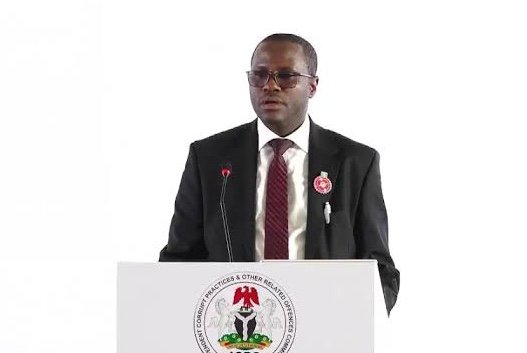
The Chairman of the Independent Corrupt Practices and Other Related Offences Commission (ICPC), Dr. Musa Adamu Aliyu, has emphasised that the fight against corruption must go beyond law enforcement and become a central component of economic governance and public administration.
Aliyu made the assertion while delivering a keynote address at the 4th Economic Confidential Lecture and 6th National Spokespersons Awards held in Abuja. According to him, integrity, transparency and accountability within public institutions are essential for achieving sustainable economic growth, attracting investment and strengthening public confidence in government.
He explained that corruption continues to undermine development efforts by diverting public resources, weakening institutions, increasing the cost of governance and discouraging both local and foreign investment.
The ICPC boss stressed that successful economic reforms depend not only on sound policies but also on the ability of government institutions to operate transparently and communicate their activities credibly to the public.
Speaking on recent anti-corruption efforts, Aliyu disclosed that the commission uncovered fresh cases of payroll fraud within the public service. He revealed that one official allegedly placed 14 members of his family on the government payroll, while another reportedly registered his wife, children and relatives as public servants and collected salaries on their behalf.
According to him, investigations uncovered about 900 suspected ghost workers whose names had already been published for verification. He noted that some fraudulent payroll entries appeared genuine, complete with names and official email addresses, but were linked to bank accounts belonging to entirely different individuals.
Aliyu said the commission recovered more than ₦24 billion from ghost pension-related fraud in 2024 alone, highlighting the scale of financial leakages within public institutions.
He further stated that the ICPC is increasingly focusing on preventive measures rather than relying solely on prosecution. He identified reforms such as the Treasury Single Account (TSA), the Integrated Personnel and Payroll Information System (IPPIS), whistleblower policies, beneficial ownership transparency and digital governance initiatives as important tools in strengthening accountability.
The ICPC chairman also disclosed that between 2023 and June 2026, the commission tracked 4,582 public projects valued at over ₦22.53 trillion. Through its Constituency and Executive Projects Tracking Initiative, projects worth over ₦507 billion were returned to construction sites, while government savings of approximately ₦385.62 billion were achieved.
Minister of Information and National Orientation, Mohammed Idris, who also spoke at the event, argued that Nigeria’s anti-corruption campaign should place greater emphasis on building institutions capable of preventing corruption before it occurs.