

More than 200 Indian companies now operate across Nigeria, and together they employ close to 100,000 Nigerians, a footprint large enough to make Indian businesses the country’s second-biggest source of jobs after the Federal Government itself. That figure, disclosed by Indian High Commissioner to Nigeria Abishek Singh, says something about the relationship between the two countries that trade numbers alone tend to miss.
The trade numbers are still striking on their own. Bilateral trade between India and Nigeria climbed 26 percent in 2025-26, reaching roughly $9 billion, up from $7.13 billion the year before. But the more significant shift may be in what’s driving that growth. The relationship is moving away from one built primarily on oil and raw commodity exports, and toward one increasingly anchored in manufacturing, healthcare, energy, technology, and direct job creation inside Nigeria.
That shift shows up clearly in how Indian companies are now operating. Rather than simply exporting finished goods into the Nigerian market, more firms are building actual production and manufacturing capacity within the country, spanning pharmaceuticals, power, construction, consumer goods, and healthcare services.
Pharmaceuticals in particular has become a flagship example of that pattern. India’s Deputy High Commissioner to Nigeria, Vertika Rawat, said Indian pharmaceutical exports to Nigeria totaled $315 million in 2024-25, with India now supplying around 40 percent of Nigeria’s pharmaceutical imports overall, and over 90 percent in certain drug categories. Indian investment in pharmaceutical manufacturing within Nigeria has reached approximately $4 billion, Rawat said, a figure that reflects a deliberate move toward producing medicines locally instead of depending on finished imports. That local production push is expected to generate skilled jobs, strengthen Nigeria’s supply chains, and build up domestic manufacturing capacity over time.
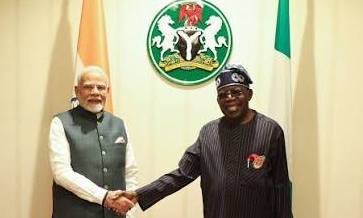
None of this is happening in a vacuum. The two countries have maintained economic ties for more than sixty years, formalized into a Strategic Partnership in 2007, and political engagement has kept pace with the economic relationship. President Bola Tinubu traveled to India for the 2023 G20 Summit, and Prime Minister Narendra Modi made a reciprocal visit to Nigeria in November 2024.
India’s involvement in Nigeria also extends beyond private capital. Through its Indian Technical and Economic Cooperation programme, India has offered development assistance, concessional financing, and technical training, giving Nigeria access to capital, expertise, and technology aimed at building up its own productive capacity, not just consuming Indian exports.