

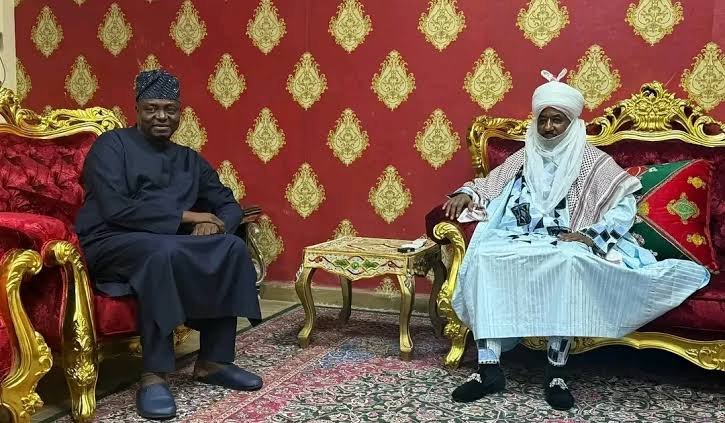
APC National Chairman Prof. Nentawe Yilwatda’s visit to Emir Muhammadu Sanusi II in Kano on Tuesday wasn’t just a courtesy call ahead of the 2027 elections. It reopened a pointed argument about political influence in Kano that has been simmering since Sanusi’s earlier removal from the throne: whether real electoral power in the state runs through him, or through the rival emir some had expected the APC to court instead.
Yilwatda, accompanied by senior APC figures and party leaders in Kano, met with Sanusi behind closed doors at the Kofar Kudu Palace for several hours. No details of the discussion were released publicly, but a palace source described the meeting as centered on APC’s 2027 preparations and its effort to solidify support within Kano specifically. “The national leadership of the APC was here to solicit the palace’s support and endorsement of all APC candidates in Kano. They have realised the dynamics of Kano politics,” the source said, pointing to Sanusi’s grassroots reach and his standing within the traditional council as reasons the party sought him out directly.
That same source went further, suggesting the visit reflected lessons the APC had drawn from a previous election cycle. “I want to believe that the APC is aware of the strength and capacity of the Emir of Kano during the last election, even with a sitting governor,” the source said, framing the outreach as a deliberate attempt to rebuild political strength through the palace after past setbacks.
Not everyone read the visit the same way, though the disagreement wasn’t over whether the meeting made sense, but over what it implied about a different emir entirely. Some had questioned whether Yilwatda’s choice to meet Sanusi, rather than the 15th Emir of Kano, Alhaji Aminu Ado Bayero, amounted to a political misstep. Public affairs analyst Usman Usman rejected that framing outright, arguing the meeting should be understood simply as part of APC’s broader network-building in Kano, not as a snub carrying deeper consequences.
Usman used the moment to push back harder on assumptions about Ado Bayero’s actual electoral weight. “Political influence is not measured merely by claims of popularity. If an individual is said to command a decisive electoral following, such influence should be demonstrated through observable political outcomes,” he said, pointing to the 2023 Kano governorship election as a test case. Ado Bayero had been widely associated with former Governor Abdullahi Umar Ganduje and APC candidate Nasiru Gawuna during that race, yet the APC lost the governorship, including, notably, at the polling unit tied to the emir’s own palace, before losing further at the local government and state levels as well.
“This raises a fundamental question: If Aminu Ado’s political following was as extensive and electorally consequential as the article suggests, where was the evidence of that influence at the ballot box?” Usman asked, arguing that Sanusi, despite his earlier removal under the previous APC-led administration, has retained more genuine public visibility and grassroots networks than his successor.