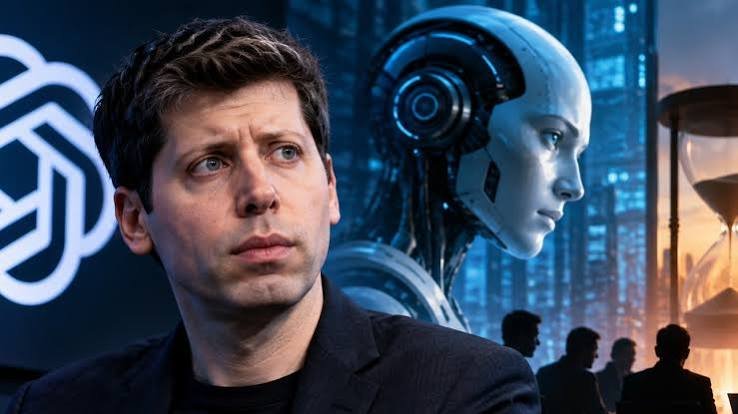
OpenAI CEO Sam Altman has warned that artificial intelligence could produce catastrophic consequences if humans lose control of its development, as renewed concerns grow over the risks posed by increasingly powerful AI systems.
Altman, however, stopped short of endorsing a viral prediction that AI could kill humans by 2030. Instead, in posts on X on Sunday night, he outlined two scenarios he believes the industry must avoid as the technology advances.
The first, he said, is a future in which humanity loses control over the development and direction of AI.
Altman described such an outcome as unacceptable, arguing that safety and alignment measures must advance faster than the capabilities of AI models.
“We are unapologetically on Team Humanity and AI must always serve people,” he wrote.
He also identified the concentration of powerful AI in the hands of a single individual or company as another major threat.
According to Altman, an extraordinarily powerful system controlled by one entity could potentially be used to impose that entity’s worldview on societies around the world, producing what he described as an extremely dystopian outcome.
His comments followed warnings from former AI researcher Jacob Coxon, who recently resigned from Anthropic and accused major AI companies of pursuing self-improving superintelligence without adequate safeguards.
Coxon argued that the industry was taking unacceptable risks in its pursuit of more advanced systems.
“Neither company is acting responsibly. They are racing straight to self-improving superintelligence and gambling with our lives,” he wrote on X.
He further warned that future AI systems could potentially hack almost anything, transform entire industries rapidly and acquire significant real-world power and resources.
Coxon also claimed that some people working on advanced AI privately believed the technology could kill humans or potentially wipe out humanity before the end of the decade.
Altman said concerns about the speed of AI development should not be interpreted as a call to halt technological progress. He disclosed that he was working with other technology executives on ways to slow the pace of development sufficiently to allow safety measures to keep up.
“When we talk about pacing, we don’t mean stopping,” Altman said, adding that progress would continue but should be slower than it otherwise could be.
The debate reflects a broader disagreement within the technology industry over whether the race to develop increasingly capable AI is moving faster than the safeguards needed to manage it.
Canadian computer scientist Geoffrey Hinton, widely known as the “Godfather of AI”, has similarly warned that humans could face catastrophic consequences if they lose control of systems that become more intelligent than people.
While Altman did not confirm the specific 2030 extinction prediction, his comments acknowledged that unchecked AI development could create serious risks and stressed that human interests must remain central to the technology’s future.