On Saturday night, something remarkable happened in Lagos.
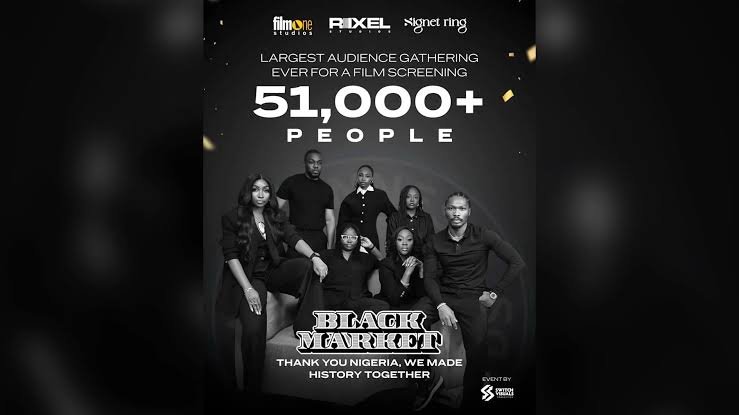
More than 51,000 people gathered at Tafawa Balewa Square to watch a single Nigerian film, Black Market, setting a new Guinness World Record for the largest attendance at a film screening in one location. The feat surpassed the previous record of 43,624 people set by the Philippine film Felix Manalo in 2015.
For many observers, it was another headline.
For others, it was something deeper.
It was another chapter in what appears to have become a uniquely Nigerian phenomenon: the relentless pursuit of world records.
Over the past few years, Nigerians have repeatedly pushed themselves into the global spotlight through Guinness World Record attempts. From cooking marathons and chess challenges to drumming, reading and now filmmaking, the country has developed an unusual relationship with record-breaking.
The question is no longer whether Nigerians will attempt another world record.
The question is why.
A Night That Changed Nollywood History
The crowd began gathering hours before the screening.
By the time the movie started, Tafawa Balewa Square had transformed into something rarely seen in global cinema history.
When Guinness World Records officials confirmed that more than 51,000 people had successfully participated in the screening, celebrations erupted across the venue.
The achievement was significant for more than one reason.
For decades, Nollywood has been measured largely by the number of films it produces.
Today, it is increasingly being judged by its global influence.
Black Market, directed by Fatimah Binta Gimsay and produced by Rixel Studios, Signet Ring Studios and FilmOne Studios, did not simply premiere a movie. It demonstrated the scale of audience engagement Nigerian cinema can command.
The message was clear:
Nollywood is no longer merely Africa’s largest film industry by volume.
It is becoming one of the world’s most influential cultural forces.
The Guinness Generation
The achievement joins a growing list of records associated with Nigerians.
In recent years, names such as Hilda Baci, Tunde Onakoya and others have become familiar far beyond Nigeria’s borders because of their Guinness World Record attempts.
What makes these stories resonate is not merely the records themselves.
They tap into something deeper.
For many young Nigerians navigating economic uncertainty, unemployment challenges and global stereotypes, record-breaking has become a way of demonstrating excellence on an international stage.
Each successful attempt becomes more than an individual achievement.
It becomes a national moment.
Social media reactions often reveal this sentiment.
When Nigerians celebrate these records, they are often celebrating possibility itself.
Beyond Entertainment
The significance of the Black Market record extends beyond cinema.
For years, conversations about Nigeria on the international stage have frequently centred on insecurity, economic challenges and political controversies.
Record-breaking moments offer a different narrative.
They showcase creativity.
They highlight innovation.
They place Nigerian talent at the centre of global conversations.
The Lagos screening brought together filmmakers, actors, government officials, corporate organisations and ordinary movie lovers in pursuit of a common goal.
That level of collaboration is itself noteworthy.
A New Kind of Soft Power
Countries often project influence through what experts describe as “soft power” — culture, entertainment, sports and ideas.
Hollywood has long served as an instrument of American cultural influence.
K-pop transformed South Korea into a global cultural powerhouse.
Bollywood helped export Indian culture to audiences worldwide.
Increasingly, Nollywood is doing something similar for Nigeria.
Films, music and digital content are reaching audiences across Africa, Europe, North America and beyond.
The Black Market record is another indication of that growing influence.
When tens of thousands gather to watch a Nigerian story told by Nigerian creatives, it sends a powerful signal about the industry’s evolution.
Why Records Matter
Critics occasionally dismiss Guinness World Record attempts as publicity stunts.
Yet their impact often extends beyond publicity.
Records create visibility.
They attract investment.
They generate tourism interest.
They stimulate conversations about industries and sectors that might otherwise receive limited attention.
The global attention generated by the Black Market screening will likely introduce new audiences to Nigerian filmmaking.
That visibility has value.
More Than Numbers
Perhaps the most interesting aspect of Nigeria’s record-breaking culture is that the records themselves are rarely the entire story.
Hilda Baci’s cook-a-thon was not simply about cooking.
Tunde Onakoya’s chess marathon was not simply about chess.
And the Black Market screening was not simply about attendance figures.
Each became a symbol of ambition.
Each became a statement that Nigerians can compete on global platforms.
Each became a reminder that talent can emerge from anywhere.
What Comes Next?
The Guinness World Record earned by Black Market may eventually be surpassed.
Records, by their nature, are made to be broken.
But the larger story may endure.
The achievement reflects a generation of Nigerians increasingly determined to be seen, heard and recognised beyond traditional boundaries.
Whether through technology, sports, entertainment, entrepreneurship or creativity, Nigerians continue finding new ways to place themselves on the global map.
On that Saturday night in Lagos, 51,000 people gathered to watch a film.
But perhaps they were participating in something bigger.
Perhaps they were helping tell a story about a country that continues to reinvent itself, challenge expectations and remind the world that Nigerian ambition rarely recognises limits.