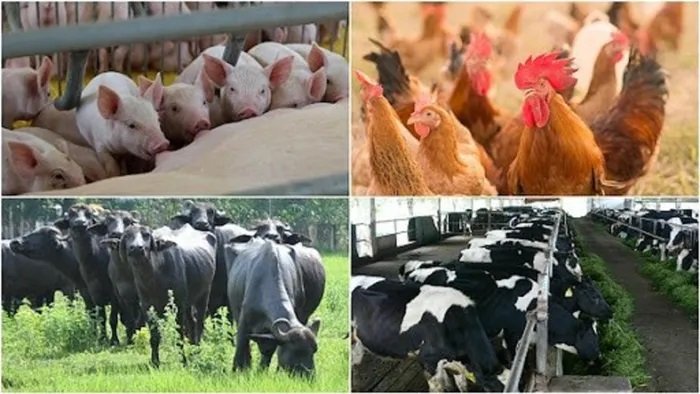
The Federal Government has unveiled an ambitious plan to expand Nigeria’s livestock industry from its current estimated value of $32 billion to about $92 billion within five years, as part of efforts to strengthen the sector’s contribution to the national economy.
The government said the livestock industry has significant potential to create jobs, improve livelihoods and attract investment across its various value chains, with the possibility of contributing up to 10 per cent to Nigeria’s Gross Domestic Product.
The Minister of Livestock Development, Idi Mukhtar-Maiha, disclosed the target during the weekend in Abuja at the presentation of a book titled Guide to Self-Employment and Sustainable Retirement Plan Through Livestock Production, authored by Dr Gabriel Ugwu.
The minister, who was represented at the event by his Special Adviser, Prof Eustace Iyayi, said the Federal Government was deliberately promoting livestock production as an avenue for employment, investment and sustainable income, particularly for people seeking opportunities before or after retirement.
Iyayi said the creation of the Federal Ministry of Livestock Development under President Bola Tinubu had provided a dedicated institutional framework for addressing challenges within the sector and exploiting its economic opportunities.
According to him, achieving the $92 billion target would require increased economic activity across livestock production, processing, marketing and other related areas.
“We want to grow the sector from the current $32 billion to about $92 billion in the next five years,” Iyayi said, adding that the government was also working towards increasing the sector’s contribution to national GDP.
He said the Nigerian Livestock Growth Acceleration Strategy, approved by the National Economic Council, was guiding the government’s intervention. The strategy covers areas including production and market access, animal health, disease control, feed and fodder, water resources, infrastructure, peace-building, youth and women participation, finance and insurance, as well as data management.
Iyayi also disclosed that the government had digitalised the country’s 417 grazing reserves and introduced a ranching policy as part of efforts to modernise livestock production.
The World Bank’s Task Team Leader for the Livestock Productivity and Resilience Support Project, Chigozie Anyiro, described the sector as an underdeveloped economic opportunity capable of supporting wealth creation and employment.
Anyiro said livestock currently contributes more than $32 billion annually to the economy and supports the livelihoods of over 30 million Nigerians. He cited the country’s livestock inventory as including more than 58 million cattle, 64 million sheep, 124 million goats and about 660 million poultry birds.
Former TETFund Executive Secretary, Prof Suleiman Bogoro, called for greater investment in research and development, arguing that innovation and entrepreneurship would be essential to unlocking the sector’s potential and supporting Nigeria’s broader economic ambitions.