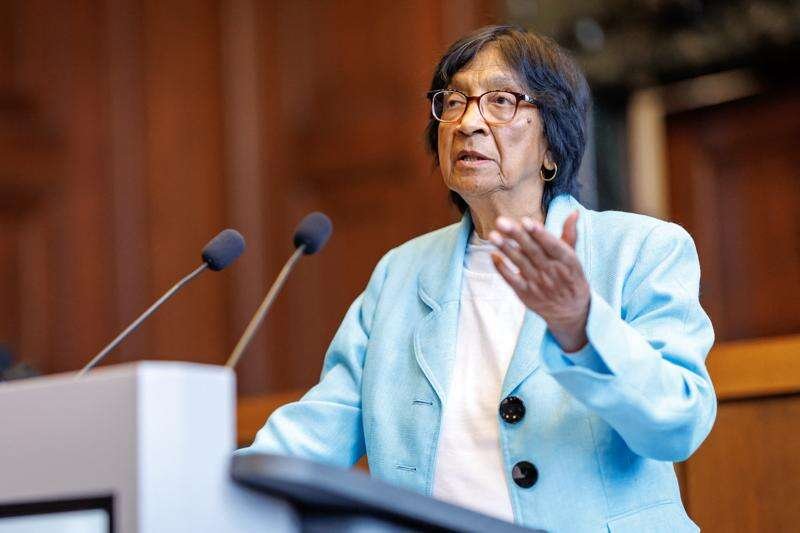
South African jurist Navanethem “Navi” Pillay has won the 2026 Nobel Peace Prize for her decades-long efforts to strengthen international law, defend human rights and ensure that perpetrators of grave crimes face justice.
Announcing the award on Friday in Oslo, the Norwegian Nobel Committee recognised Pillay for her work promoting peace and international legal principles, highlighting her role in advancing accountability for war crimes, crimes against humanity and genocide.
The committee said her career demonstrated the importance of a rules-based international order at a time when legal institutions face mounting political pressure and governments increasingly challenge established mechanisms of accountability.
Pillay’s path to the Nobel began under apartheid in South Africa, where she grew up in Durban in a family of Indian Tamil descent. Born on September 23, 1941, she became a lawyer during a period when racial discrimination restricted the rights and opportunities of millions of South Africans.
In 1967, she established her own law firm in Natal, now KwaZulu-Natal, becoming the first woman to do so in the province. Her legal work included defending anti-apartheid activists and challenging abuses by the state, including the mistreatment of political prisoners.
After apartheid, Pillay continued to break barriers in the legal profession. She became an acting judge of South Africa’s High Court in 1995, before moving into international judicial service.
One of the defining chapters of her career was her work at the International Criminal Tribunal for Rwanda, where she served as a judge from 1995 to 2003 and later became its president.
The tribunal was established by the United Nations to prosecute those responsible for atrocities committed during Rwanda’s 1994 genocide. Pillay’s work there contributed to landmark developments in international criminal law, particularly the recognition of sexual violence as a potential instrument of genocide.
The case against former Taba mayor Jean-Paul Akayesu established an important precedent: rape and other forms of sexual violence could constitute acts of genocide when committed with the required intent to destroy a protected group. The proceedings also advanced the prosecution of incitement to genocide through propaganda.
Pillay subsequently served as a judge at the International Criminal Court before becoming United Nations High Commissioner for Human Rights in 2008, a position she held until 2014.
In that role, she advocated stronger protection of fundamental freedoms, accountability for human rights violations and greater recognition of the rights of women and vulnerable communities.
Her more recent work has placed her at the centre of contentious debates over international accountability. As chair of the UN Independent International Commission of Inquiry on the Occupied Palestinian Territory, including East Jerusalem, and Israel, she led a commission whose 2025 report concluded that Israel had committed genocide against Palestinians in Gaza. Israel rejected the allegation.
Pillay has also served as an ad hoc judge at the International Court of Justice in the case brought by The Gambia against Myanmar over alleged violations of the Genocide Convention concerning the Rohingya minority. The proceedings reflect her continuing involvement in efforts to establish state responsibility under international law.
The Nobel award comes amid growing disputes over the authority and effectiveness of international legal institutions. The committee argued that peace requires more than an end to armed conflict: it also depends on justice, accountability and respect for human dignity.
Pillay’s career has not eliminated the difficulties of enforcing international law, but her work has helped shape the legal standards through which serious abuses can be investigated and prosecuted.
Her Nobel Peace Prize will be formally presented at the award ceremony in Oslo on December 10, the anniversary of Alfred Nobel’s death.
From challenging racial injustice at home to helping develop international criminal jurisprudence, Pillay’s career has been defined by the principle that neither political power nor national borders should place perpetrators of grave crimes beyond the reach of the law.