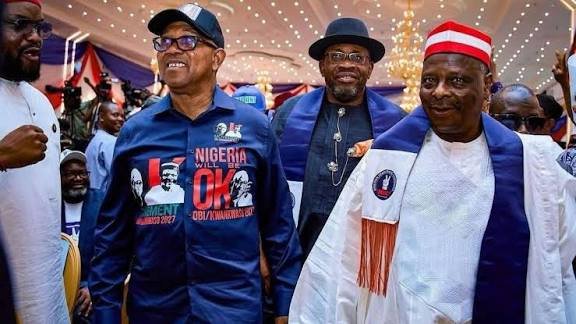
A fresh disagreement has emerged within the political camp supporting Peter Obi and Rabiu Kwankwaso ahead of the 2027 general elections, following criticism of the Nigeria Democratic Congress (NDC) over the composition and timing of its newly announced National Campaign Council.
The Obi-Kwankwaso (OK) Movement accused the party of failing to establish an effective grassroots mobilisation structure, questioning its preparedness to conduct a nationwide presidential campaign.
In a statement issued in Abuja on Monday, the movement’s Director-General, John Ughulu, argued that the NDC had delayed setting up its campaign machinery despite the approaching elections.
He challenged the party’s leadership to explain its campaign strategy and the organisational arrangements already established across the country.
“With less than three months to the general elections, they are only just announcing their Presidential Campaign Council. What exactly have they been doing all this time?” Ughulu asked.
The criticism followed Sunday’s announcement of the NDC National Campaign Council, which is expected to be inaugurated in the Federal Capital Territory.
The party named its National Leader, Senator Seriake Dickson, as council chairman, with presidential candidate Peter Obi serving as co-chairman.
NDC National Chairman, Senator Cleopas Moses Zuwoghe, was appointed vice-chairman, while Obi’s running mate, Rabiu Kwankwaso, was named co-vice-chairman.
Other appointments included former Secretary to the Government of the Federation, Babachir Lawal, as chairman of the National Advisory Council.
Former Deputy Senate President Ovie Omo-Agege, political economist Pat Utomi and former Congress for Progressive Change National Secretary Buba Galadima were also listed among the council members.
The party appointed its National Secretary, Ikenna Enekweizu, as council secretary, while Ibrahim Abdulkarim was named Director-General.
However, Ughulu and other officials of the OK Movement were excluded from the appointments, including its coordinators at state, local government and ward levels.
Their omission comes amid an ongoing disagreement over the movement’s organisational independence and its relationship with the party’s presidential campaign.
Ughulu maintained that the movement possessed a stronger grassroots network than the structures assembled by the NDC.
He predicted that several members of the campaign council would eventually seek assistance from the movement to mobilise voters.
“The funny part of this list is that 90 per cent of the people on it will still come knocking on the doors of the OK Movement,” he declared.
The movement’s claims have not been independently established, and the NDC’s response to the latest criticism was not included in the statement.
The disagreement raises questions about coordination between the party’s formal campaign leadership and independent support organisations backing its presidential ticket.
With the election approaching, attention will turn to whether both groups can resolve their differences and establish a coordinated campaign structure.
Ezeana Emmanuel