The Federal Government has agreed to introduce a six-month transport intervention of ₦70,000 for workers beginning in November 2026, following negotiations with the Nigeria Labour Congress (NLC) over rising living costs and outstanding welfare obligations.
The agreement also provides for the settlement of 19 months’ unpaid allowances owed to health workers and the commencement of fresh minimum wage negotiations.
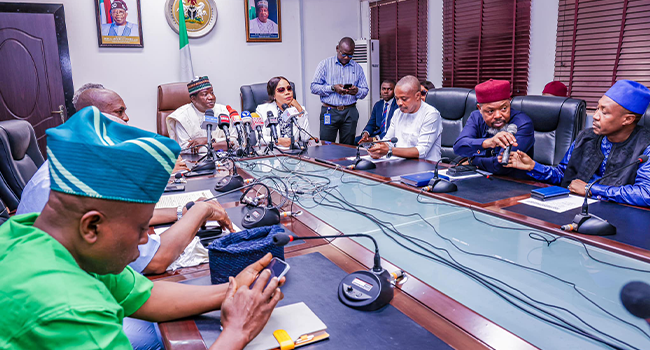
The resolutions were reached during a conciliation meeting at the Federal Ministry of Labour and Employment on Tuesday, October 27, following an earlier engagement on October 22.
Both meetings were convened to address concerns surrounding petroleum prices, workers’ purchasing power, minimum wage implementation and outstanding allowances.
Under the agreement, the transport intervention will apply across all levels for six months, although the statement did not specify whether the ₦70,000 would be paid monthly or as a single amount.
The government also approved the payment of the peculiar allowance, effective May 1, 2026.
Arrears arising from the allowance will be settled in three equal monthly instalments beginning in November.
For health workers, the government committed to clearing 19 months of outstanding allowances within three months, with payments scheduled to commence in December 2026.
The parties further agreed that a Minimum Wage Negotiation Committee should be constituted immediately to begin discussions on a new wage arrangement.
However, they failed to reach a consensus on the effective date for implementing the proposed minimum wage.
Tax relief for workers was another issue considered during the negotiations.
The meeting resolved to refer the matter to the National Executive Council because taxation falls within a statutory framework.
Meanwhile, the proposed hazard allowance for agricultural officers is undergoing administrative review.
The Federal Ministry of Agriculture and Food Security has submitted the list of beneficiaries and estimated financial implications to the National Salaries, Incomes and Wages Commission (NSIWC).
The commission is expected to complete verification within two weeks and subsequently issue an implementation template.
Similarly, the NSIWC has been given three weeks to update the financial assessment of the proposed Consolidated Health Salary Structure (CONHESS) adjustment.
The assessment will guide the Presidential Committee on Salaries in reaching a decision on the proposal.
Beyond federal institutions, the government and organised labour encouraged state and local governments to participate in the intervention process and implement applicable resolutions.
Both parties agreed to reconvene after one month to assess progress and determine whether the commitments were being fulfilled.
The agreement was signed for the government by Minister of Labour and Employment Muhammad Maigari Dingyadi, Budget Director-General Timi Yakubu and senior civil service representative Garba Abdul S. U.
NLC President Joe Ajaero signed on behalf of organised labour, while Olowoyo Gbenga represented the Joint National Public Service Negotiation Council.
The next review meeting will provide an opportunity to assess whether the promised payments and administrative measures have commenced as scheduled.
Ezeana Emmanuel