


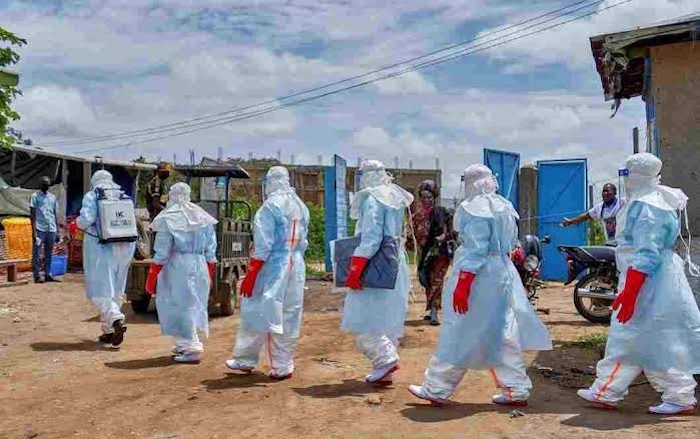
Somewhere in eastern Congo, an 18-month-old girl developed a fever. Her family carried her on foot to one health centre, then another. She was given antibiotics. She was not tested for Ebola. By the time her positive result came back, she was dead. At least 107 people had come into contact with her along the way.
That sequence of events is the summary of Democratic Republic of Congo’s current Ebola outbreak.
The World Health Organisation confirmed this week that confirmed cases in DRC have surpassed 1,000, with 254 deaths recorded across an outbreak now concentrated in three displacement camps in eastern Congo, including Hungbe and Kpangba. The case fatality rate sits at roughly 25%, consistent with previous Ebola outbreaks but devastating in communities already hollowed out by conflict, displacement, and collapsing health infrastructure.
The numbers are alarming are alarming and the conditions producing them are more so.
Eastern Congo’s displacement camps were not built to contain an infectious disease outbreak. They were built to house people fleeing armed conflict, and they have been doing that under severe strain for years. Isolation facilities are in short supply, testing capacity has not kept pace with case volume, healthcare workers are operating in an environment where the basic infrastructure required to break a transmission chain, a functioning triage system, rapid diagnostic access, and adequate isolation space, is either absent or overwhelmed.
The result is a chain of events like the one that killed an 18-month-old before anyone confirmed what she had.
UNICEF has noted that nearly one in five confirmed cases in the current outbreak are children, a figure that reflects both the demographics of displacement camp populations and the particular vulnerability of young children in high-contact, low-sanitation environments.
A small number of cases have been confirmed in neighbouring Uganda, raising the possibility of cross-border spread through population movement along routes that are difficult to monitor and harder still to close. African health experts have warned that without a significant escalation in the response, the outbreak has the potential to grow beyond its current projections.
The 2014 to 2016 West Africa Ebola epidemic, the largest in recorded history, killed over 11,000 people. This was as a result of delayed international response, weak health systems, and transmission chains that moved faster than containment efforts.
One thousand cases is not yet a catastrophe. It is, however, a number that arrived because a toddler with a fever could not get a test in time.