


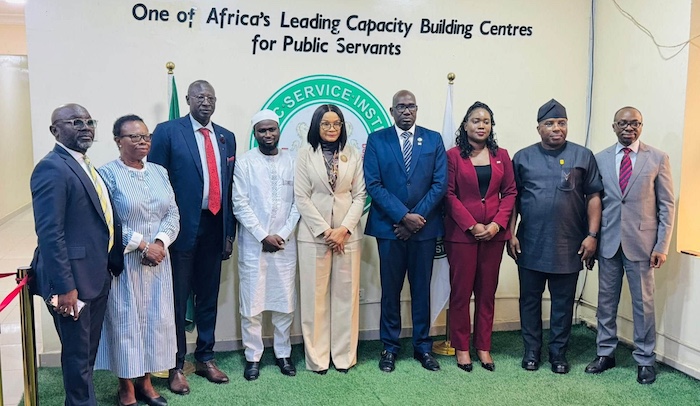
The Gambia has signalled its intention to draw on Nigeria’s civil service reforms to improve public service delivery at home, as a Gambian delegation wraps up a study visit to Abuja.
Secretary to the Cabinet and Head of the Civil Service of The Gambia, Alieu Njie, made the commitment on the sidelines of a meeting with Imeh Okon, Administrator of the Public Service Institute of Nigeria (PSIN). The delegation was in Nigeria from June 20 to 24 to understudy Nigeria’s civil service transformation and institutional practices, with the visit also designed to deepen cooperation between the two countries through peer learning and exchange of reform experiences.
Njie said the visit built on longstanding historical and diplomatic ties between both countries, tracing the relationship to their shared colonial experience and the diplomatic bonds forged since independence. He noted that this was the first time the Gambian Head of Civil Service had paid an official visit to Nigeria’s Head of Service, describing the occasion as a significant step in formalising institutional ties between the two public services.
“History does not start today. Since after independence, these two countries share the same colonial antecedent. We are continuing the diplomatic ties between the two countries,” he said.
Njie said lessons from the visit would be shared across the Gambian civil service to improve efficiency and service delivery. “We are working towards learning what Nigeria has done and what Nigeria is doing, to ensure that we replicate that in my country. This is why we are here,” he said.
He described Nigeria as a preferred partner, citing its depth of technical expertise across multiple sectors. “Nigeria has always been our big brother. There are so many things you can learn from Nigeria. Most of our civil servants went to school here, including myself. Even in defence, health and technical assistance, we have been benefiting from Nigeria,” Njie said.
Responding, Okon said the visit offered both institutions an opportunity to identify areas of collaboration and assess where each side’s expertise could be of mutual benefit. She said initial discussions had focused on understanding how both institutions operated, with further engagements to centre on training needs and structured knowledge sharing.
“By the time both of us sit down to identify the different pathways through which we have been engaging the public sector in our countries, we can easily identify areas where our expertise can also be adopted by the Gambian civil service,” she said.
Okon described the engagement as the beginning of a longer process. “For me, this is just the early days of an ongoing engagement to review the offerings from both sides and determine how we can benefit from each other,” she added.