


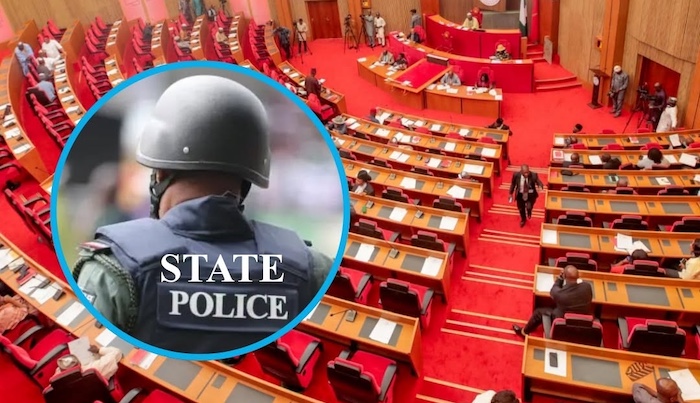
The Nigerian Senate has pushed back against suggestions that the State Police Bill passed last week was a politically motivated exercise, releasing figures and a detailed account of the consultation process that produced it to make the case that the reform is grounded in national security necessity rather than partisan calculation.
Senate Leader Opeyemi Bamidele, in a statement issued Sunday, described the bill as a child of necessity, noting that the proposal did not emerge suddenly but evolved through years of constitutional review, public hearings across all six geopolitical zones, and stakeholder engagement with the Executive, the Nigerian Governors’ Forum, the Conference of Speakers of State Legislatures, and the leadership of the Nigeria Police Force itself.
The vote count is the most direct rebuttal to the political motivation argument. Eighty-four of 109 senators voted in favour of the bill during clause-by-clause consideration, a 77% approval margin. Bamidele noted that the majority extended beyond the APC, with members of the PDP, ADC, NDC, and Labour Party exercising their discretion in favour of the legislation on national interest grounds. A bill that clears the Senate with cross-party backing and a 77% vote share is a harder target for the partisan framing than one that squeaks through on a ruling party majority alone.
The Nigeria Police Force’s role in shaping the bill was highlighted as further evidence of its legitimacy. Bamidele said the police made recommendations during the drafting process and that many were incorporated, particularly around accountability and oversight mechanisms designed to prevent abuse by state governors. The force’s support, he argued, underscores the strategic case for state policing rather than undermining it.
The safeguards built into the legislation reflect the most persistent criticism of the reform which is, state police formations could become instruments of political intimidation. The bill addresses this by requiring governors to have their appointments of State Commissioners of Police confirmed by their respective State Houses of Assembly. Any removal must be recommended by the National Police Council and approved by a two-thirds legislative majority. Each state must also establish a State Police Service Commission to govern recruitment, promotions, and discipline. No state police service can begin operations until it has been certified by the National Assembly as meeting nationally prescribed operational standards.
The bill has now been transmitted to the 36 State Houses of Assembly, where ratification by at least 24 is required before it can proceed to President Bola Tinubu for assent. The consultation process that produced the bill took years. The ratification process now beginning will test whether the consensus Bamidele described at the national level holds at the state level, where the politics of policing tend to be considerably more immediate.