

Former President Olusegun Obasanjo has warned that many of the conditions which led to Nigeria’s Civil War remain unresolved today, insisting the country must do everything possible to avoid a repeat of that conflict.
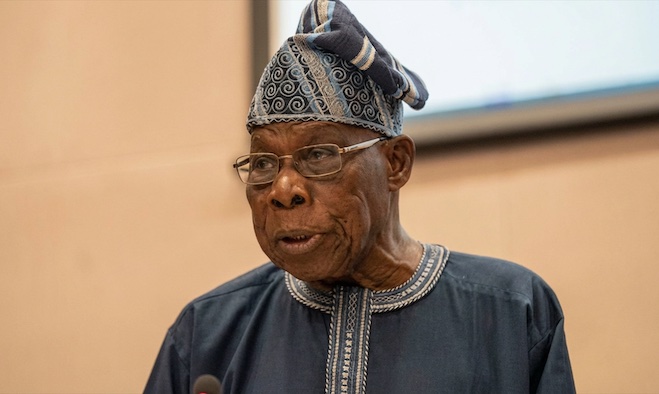
Speaking in Abeokuta at the Olusegun Obasanjo Presidential Library, during the presentation of a historical document titled Asaba Massacre by Isama Aje of Asaba, Chief Chuck Nduka-Eze, Obasanjo said the underlying issues that sparked the war decades ago have never really gone away. “Some of the things that led to the civil war are still on. Now, how long will this be with us?” he asked, recalling a conversation in which General Yakubu Gowon once said Nigeria would not survive a second civil war. Obasanjo said he shares that view, adding that the country has already fought one war too many and that acknowledging past atrocities, condemning them, and committing to prevent their recurrence is the only path toward genuinely being able to say “never again.”
He framed the Asaba document itself as part of that process, describing preservation of painful history as essential to learning from it. “We pride ourselves that we preserve the past, we capture the present, and we inspire the future,” he said.
Obasanjo, who fought in the civil war himself, said he has never been able to speak in detail about the Asaba Massacre because the area fell under the command of Murtala Muhammed at the time. He said he is frequently asked about Murtala’s role in the Asaba operations but has always declined to comment, promising instead to review the transcripts and audiovisual material presented at the event. He did, however, recall intervening personally during the war to stop a soldier from raping a woman in Asaba, an act he said would have exposed him to vicarious liability had he not acted.
Nduka-Eze, presenting his findings, said the document draws on eyewitness testimony, recorded interviews, archival records and existing historical scholarship to reconstruct what happened after federal troops entered Asaba, then a civilian population center in the Mid-West Region. He described a consistent pattern across independent sources. Civilians were gathered in public spaces and pressured to declare loyalty to Nigeria, including chanting “One Nigeria,” believing the display of allegiance would guarantee their safety. Men were then separated from women and children, and unarmed male civilians were killed. “Compliance with these demands did not secure protection,” he said, calling it a tragic contradiction in which people who affirmed their loyalty to the state were killed by that same state.
While exact casualty figures cannot be confirmed, Nduka-Eze said the evidence points to more than a thousand civilian deaths and lasting damage to the Asaba community. He echoed Obasanjo’s warning, noting that ethnic suspicion among Nigerian groups persists to this day.