


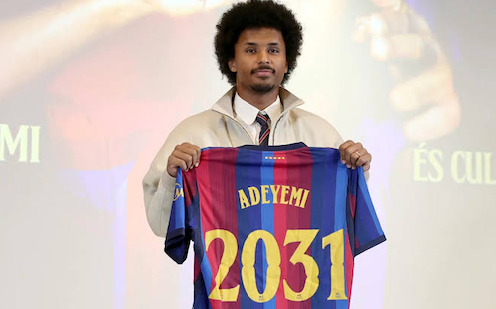
Barcelona’s decision to sign German forward Karim Adeyemi from Borussia Dortmund is about more than adding another attacker, signalling a broader shift in how the Spanish champions intend to rebuild their frontline under head coach Hansi Flick.
The Catalan club confirmed on Thursday that Adeyemi had signed a five-year contract until June 2031 after completing a reported €29 million move, including add-ons. At a time when transfer fees for elite attackers continue to soar, Barcelona have secured a 24-year-old Germany international entering his prime for what many would consider a relatively modest fee.
The move addresses an immediate need following the departure of veteran striker Robert Lewandowski and the end of Marcus Rashford’s loan spell from Manchester United. However, Adeyemi is unlikely to be viewed as a like-for-like replacement for either player.
Instead, he brings a different profile to Barcelona’s attack.
Known for his blistering pace and ability to play across the front three, Adeyemi offers the tactical flexibility that has become a hallmark of Flick’s football. Comfortable as a centre-forward or on either wing, he excels at stretching defences, making runs behind opposition backlines and pressing aggressively without possession.
Those qualities align closely with Flick’s high-intensity approach, which relies heavily on quick transitions and relentless pressing rather than building attacks around a traditional target man.
Statistically, Adeyemi arrives with a respectable, though not prolific, scoring record. He netted 36 goals in 146 appearances across four seasons at Borussia Dortmund, demonstrating consistency but not the output typically associated with an elite striker. His value has often extended beyond goals, with his pace, movement and ability to create space for teammates making him a constant attacking threat.
Barcelona’s reported pursuit of Atlético Madrid forward Julián Álvarez further suggests the club is not relying solely on Adeyemi to replace Lewandowski’s goals. Should Álvarez also arrive, the pair could provide complementary qualities, with the Argentine offering creativity and intelligent link-up play while Adeyemi supplies pace and directness in behind opposing defences.
Financially, the transfer also reflects a more measured recruitment strategy. In an era where proven attackers frequently command fees exceeding €50 million, Barcelona appear to have identified a player with significant upside at a comparatively reasonable cost.
More broadly, the signing reinforces the club’s changing philosophy. Rather than replacing one ageing star with another, Barcelona are assembling a younger, more dynamic attacking unit built around versatility, athleticism and tactical adaptability.
Whether Adeyemi ultimately succeeds at Camp Nou will not be judged solely by his goal tally. His ability to execute Flick’s demanding style of football, create space for teammates and inject greater pace into Barcelona’s attack may prove just as valuable as the goals he scores.
For now, the transfer represents less of a headline signing and more of a strategic investment in the club’s long-term evolution under a manager determined to reshape Barcelona’s identity.