

Twenty coastal communities in Ondo State’s oil-producing Ilaje Local Government Area have issued a stark warning to the Federal and State governments: intervene to stop the advancing Atlantic Ocean from destroying their settlements, or face a boycott of the 2027 general elections.
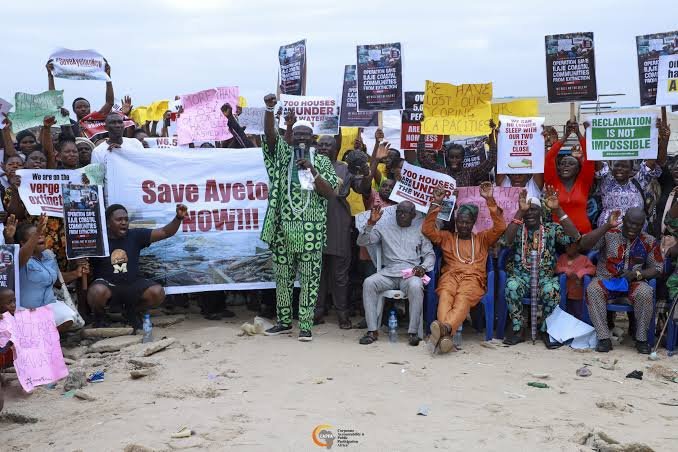
The threat came following a peaceful protest to the local government headquarters in Igbokoda, where residents described a crisis that has already consumed large parts of their communities. The demonstration, organized under the Coalition of Ilaje Ravaged Communities with advocacy support from Corporate Accountability and Public Participation Africa, began with a press conference in Ayetoro, the hardest-hit community, before moving to Igbokoda the following day.
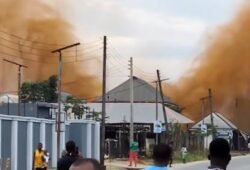
Communities spanning Ayetoro, Awoye, Mese, Gbagira, Jiringho, Ilowo, Ilepete, Idiogba, Oroto, Alagbon, Erunona, Olotu, Yaye, Womitenren, Ogboti, Lepe, Ehinmore, Abetobo, Odun-Oyinbo, and Abereke described what they called a humanitarian emergency, with the encroaching ocean destroying homes, schools, places of worship, health facilities, fishing grounds, factories, and other essential infrastructure. Ayetoro has become the starkest symbol of that devastation, a settlement once prosperous enough to have reportedly loaned money to Nigeria’s former Western Region Government, now having lost an estimated 85 percent of its territory to coastal erosion and ocean surge.
Beyond long-term shoreline protection through sea walls and groynes, the coalition is demanding immediate humanitarian relief, including food, clean water, medicine, and temporary shelter for displaced families. They’re also calling on the Federal Government to formally declare the Ilaje coastline a national disaster zone and release emergency funding, while pressing the state government to sign a memorandum of understanding and publish a 90-day action plan within a month of receiving their demands.
The election boycott threat carries a blunt message. “No project, no vote,” the coalition declared, warning political parties and candidates that coastal communities would no longer offer their support automatically. The group was careful to frame the threat not as opposition to democracy itself, but as a demand for accountability from politicians who seek their votes while overlooking their suffering. They pointed to the scale of their contribution to Ondo State’s oil economy as justification for their frustration. “You cannot take 75 per cent of our resources and give us zero per cent protection,” the coalition said.
The Monarch of Ayetoro, Oba Olorumbe Ojagbohunmi, offered a firsthand account of the devastation, describing two decades of steadily worsening ocean encroachment despite repeated community appeals. “It has been 20 years since the sea has been encroaching. The people of the community have been writing letters and making passionate appeals that we are experiencing serious environmental challenges, that the sea is coming at an alarming rate towards the residential areas of the community,” he said. He described losing at least 50 buildings annually to the ocean over the past decade, leaving his people effectively “refugees in their own town,” with only about seven of the community’s original 45 streets still standing; factories, schools, and other infrastructure now lie beneath the water.
The monarch recounted a particularly harrowing incident in April, when a nighttime disaster destroyed the road leading to the palace along with its staircase, trapping him and his family inside for a week with no way to safely leave. “We are seeking help from wherever we can get it,” he said, attributing much of the crisis to government failure, specifically citing two multibillion-naira shoreline protection contracts awarded by the federal government that were never actually executed.
CAPPA Associate Director Ogunlade Olamide framed the crisis in terms of climate and environmental justice, arguing that government at every level bears responsibility to act. “Within the context of climate justice, environmental accountability and historical liabilities, governments at the federal, state and local levels must act now to protect the Ilaje people, their homes, livelihoods and heritage,” he said. “Communities that have borne the environmental and social costs of reckless resource extraction cannot continue to be met with silence and inaction. Their call is not for charity, but a demand for justice, fairness, accountability and reparation.”
Coalition General Coordinator Comrade Akingboye Thompson described the situation as having moved well beyond a routine environmental concern. “Ilaje coastal communities are facing an existential threat. The Atlantic Ocean is swallowing our land from the sea, and poor drainage is drowning our headquarters from within,” he said, describing affected residents as “climate refugees in their own country” and noting that fishermen have lost access to traditional fishing grounds while thousands of displaced families struggle to find safe housing.
The coalition also flagged a related but distinct problem in Igbokoda itself, where inadequate drainage infrastructure has left the local government headquarters vulnerable to recurring flooding during the rainy season, and called for the immediate construction of a modern drainage network there, arguing that a seat of local government should not itself be at the mercy of annual flooding.
The communities closed their appeal by urging the Federal Government, Ondo State Government, Ilaje Local Government Council, and relevant agencies to treat the crisis as the emergency it has become, rather than waiting for additional communities to disappear entirely beneath the advancing ocean.