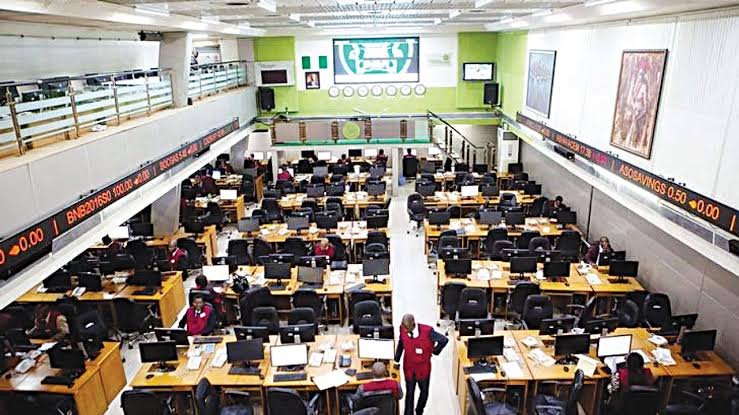
Foreign investors have pulled a net N266.07 billion from the Nigerian equities market in the first seven months of 2026, highlighting growing concerns over the market’s ability to retain international capital despite a surge in overall trading activity.
Latest data from the Nigerian Exchange Limited (NGX) showed that foreign portfolio investment (FPI) outflows have consistently exceeded inflows since 2023, with the gap widening sharply this year.
The N266.07 billion deficit recorded by July represents an increase of more than 1,073 per cent from the N22.68 billion net outflow recorded during the corresponding period of 2023.
In the first seven months of 2026, foreign investors brought N513.36 billion into the market but withdrew N779.43 billion. The figures contrast with the N609.73 billion inflow and N671.56 billion outflow recorded in the same period of 2025.
The worsening foreign position has occurred despite a significant increase in activity on the NGX. Total transactions climbed to approximately N11.98 trillion between January and July 2026, nearly twice the N6.01 trillion recorded in the corresponding period of 2025. Domestic investors, however, accounted for much of the increase.
Foreign outflows exceeded inflows in every month of the year under review. March recorded the largest monthly deficit at N74.72 billion after outflows surged to N181.77 billion against inflows of N107.05 billion.
July also raised concerns, with foreign participation falling to just 5.60 per cent. Inflows dropped 42 per cent from June to N41.59 billion, while outflows stood at N91.03 billion.
Fiona Ahimie, President of the Chartered Institute of Stockbrokers, said the trend indicated that foreign investors were still reluctant to hold Nigerian equities over the long term.
She noted that their reduced participation could affect market liquidity and leave the equities market increasingly dependent on domestic investors.
However, Ahimie said the situation should not be viewed as a collapse of the Nigerian market, pointing to improvements in naira stability, foreign exchange liquidity and external reserves.
She identified inflation, policy consistency, corporate governance, regulatory predictability and market liquidity as factors that would determine whether international investors remain in the market.
David Adonri, Managing Director of Highcap Securities Limited, offered another explanation for the large outflows, saying foreign investors may have been taking profits after the prolonged rally in Nigerian equities.
He also pointed to the release of previously trapped foreign funds, which allowed some investors to repatriate their money.
Adonri stressed that FPI is inherently mobile and can quickly move between markets in search of better risk-adjusted returns. He warned that domestic investors alone may not be sufficient to sustain the market indefinitely.
Tajudeen Olayinka, meanwhile, argued that foreign investors had not abandoned Nigeria’s capital market altogether. Rather, he said many had shifted towards fixed-income instruments, attracted by relatively high yields on government bonds and Treasury bills.
He said Nigeria still needed a healthy balance between domestic and foreign investors because international capital provides liquidity and supports stability in the foreign exchange market.
The growing challenge, therefore, may no longer be simply getting foreign investors to enter Nigeria, but creating an investment environment strong enough to convince them to stay.