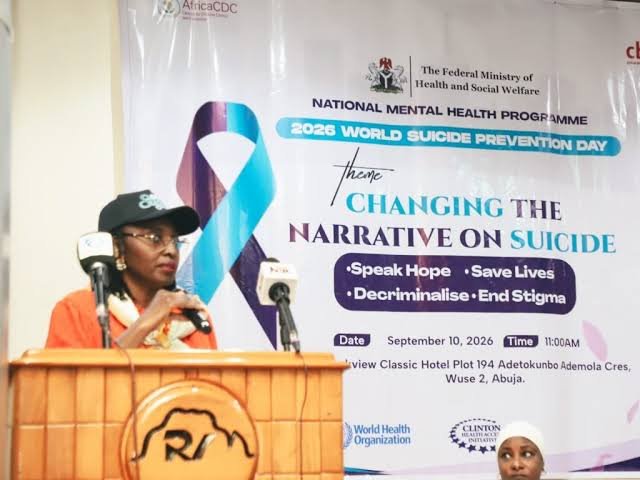
The Federal Government has commenced the process of removing criminal sanctions for attempted suicide, marking a significant shift in Nigeria’s approach to mental health and suicide prevention.
The move follows approval by the Federal Executive Council (FEC) of the position presented by the Federal Ministry of Health and Social Welfare, paving the way for legislative action at the National Assembly.
Speaking at the 2026 World Suicide Prevention Day commemoration in Abuja, the Minister of State for Health and Social Welfare, Dr Iziaq Salako, said the proposed reform reflects a growing recognition that individuals experiencing mental health crises require support and treatment rather than punishment. He was represented at the event by the Permanent Secretary of the ministry, Daju Kachollom.
According to Salako, criminalising attempted suicide can discourage vulnerable individuals from seeking help due to fear of prosecution and social stigma. He noted that removing criminal penalties would encourage more people to access mental health services and create opportunities for timely intervention.
“A person experiencing a mental health crisis should be met with care, support and appropriate intervention, rather than punishment,” he said, adding that the reform is both a legal and public health measure aimed at improving outcomes for people at risk.
The minister, however, stressed that decriminalisation alone would not solve the challenge of suicide prevention. He said the government remains committed to strengthening mental health services, expanding access to care and promoting community-based support systems across the country.
He highlighted existing policy frameworks guiding Nigeria’s mental health response, including the National Mental Health Act 2021, the National Mental Health Policy 2023 and the National Suicide Prevention Strategic Framework 2023–2030.
Mental health advocates have long argued that punitive laws targeting suicide attempts are outdated and counterproductive, particularly in a country where access to mental health services remains limited. They maintain that individuals who attempt suicide often require urgent psychological support rather than criminal prosecution.
If approved by the National Assembly, the proposed legal reform would align Nigeria with a growing number of countries that have adopted a public health-based approach to suicide prevention, focusing on treatment, rehabilitation and social support rather than punishment.