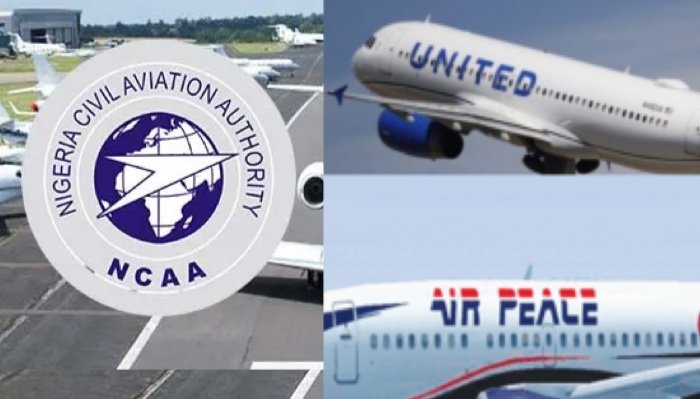
Air Peace and United Nigeria Airlines have challenged the accuracy of the Nigeria Civil Aviation Authority’s report on flight disruptions recorded by domestic airlines in August, arguing that the figures failed to account for factors beyond the carriers’ control.
The airlines said the NCAA data did not sufficiently distinguish between delays caused by internal operational problems and those resulting from airport congestion, weather, infrastructure, industrial action and other external circumstances.
The NCAA’s August report stated that domestic airlines recorded 4,801 delayed or cancelled flights out of 7,961 operations during the month.
Air Peace was listed as having the highest number of disruptions, with 1,337 delays or cancellations out of 1,864 flights. United Nigeria Airlines was credited with 951 disruptions out of 1,231 flights, while Enugu Air recorded 586 out of 878 and ValueJet 438 out of 767.
Ibom Air recorded 257 disruptions from 560 flights, while Arik operated 301 flights, of which 188 were delayed and one cancelled.
However, Air Peace Chief Operating Officer, Oluwatoyin Olajide, disputed the figures, saying the airline actually operated 2,564 flights in August, 700 more than the number contained in the NCAA report.
She argued that excluding those flights distorted the airline’s performance figures and inflated its reported delay rate.
According to Olajide, an internal analysis showed that only 391 of the airline’s August disruptions were attributable to internal factors, representing about 15 per cent of the delays.
She said these included technical problems requiring unscheduled maintenance and fuel-related issues. The remaining disruptions, she said, were caused by factors including airport congestion, bird strikes, airport facilities, adverse weather, union picketing and ground-handling damage.
Olajide also questioned why the NCAA began its monthly reporting series with August despite having published its first- and second-quarter reports in July. She said the impact of industrial action that began on August 11 lasted for more than two weeks and contributed to rescheduling, delays and cancellations.
United Nigeria Airlines similarly argued that the data needed to identify whether disruptions were controllable by airlines.
Speaking at the Aviation Day of the 23rd Akwaaba African Travel Market in Lagos, the airline’s Chief Commercial Officer, Adedayo Olawuyi, said delays should be examined as a responsibility shared across the aviation ecosystem.
Olawuyi cited airport congestion as one challenge, explaining that aircraft could sometimes be prevented from moving because of traffic on the ramp.
He also pointed to technical faults, saying airlines must prioritise safety by keeping affected aircraft out of service until repairs are completed.
Weather was another factor, he said, particularly because many Nigerian airports operate on a dusk-to-dawn basis. Delays extending into the night can therefore result in cancellations when airports lack the facilities to continue operations.
Both airlines maintained that a proper assessment of flight disruptions should account for the different causes before attributing delays to individual carriers.