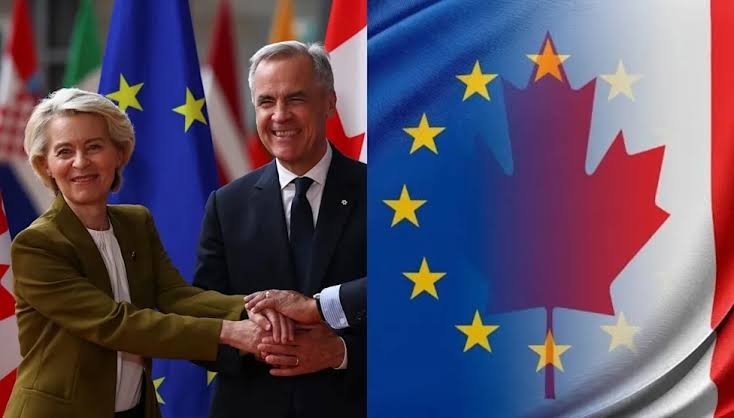
The European Commission has rejected suggestions that a proposal to establish Canada as an “associate member” of the European Union is intended as a challenge to the United States, after President Donald Trump threatened possible trade retaliation.
Commission trade spokesperson Olof Gill said Thursday that the initiative was designed to strengthen cooperation between Europe and Canada rather than target Washington.
“As our president made clear yesterday, the proposed strengthening of our partnership with Canada is not against anyone else, but for our common strength,” Gill said.
European Commission President Ursula von der Leyen proposed the new relationship during a speech to the European Parliament in Strasbourg, with Canadian Prime Minister Mark Carney in attendance.
She invited Canada to become the first country to hold the proposed associate status, suggesting cooperation in areas including critical minerals, artificial intelligence, defence manufacturing and the Arctic.
“I would like to work with you on opening the door for Canada to be the first associate member of the EU,” von der Leyen told Carney, prompting a standing ovation.
The proposal has yet to be defined in practical or legal terms, however, as existing EU treaties do not provide for an “associate member” category. Any new partnership with a non-EU country would also require approval from the bloc’s member states.
Trump reacted strongly to the proposal on Wednesday, describing it as “laughable” and warning that Washington could impose substantial tariffs on European goods or restrict trade with the bloc if he considered the move hostile.
“If they do that, if I think it’s at all a hostile act, I will put very serious tariffs or stop trading with Europe, on many things,” Trump said.
He added that the United States could impose “very heavy tariffs” if the initiative was judged to have hostile intentions.
The proposal comes as Canada seeks closer economic and strategic relations with Europe amid increasing trade tensions with the United States. Carney’s visit to Strasbourg is expected to contribute to preparations for an EU-Canada summit scheduled for Montreal next month.
French Foreign Minister Jean-Noel Barrot said France supported developing closer relations with Canada but indicated that the proposal would need to be examined before Paris took a final position.
The EU and Canada already have extensive economic and strategic ties. Their CETA free-trade agreement removed almost all tariffs between them, with trade in goods and services reported to have increased by more than 80 per cent since 2016.
Canada also became the first non-EU country this year to participate in one of the bloc’s major defence loan programmes.
Carney has been pursuing stronger European ties as Canada navigates its increasingly difficult trade relationship with the United States, while both Ottawa and Brussels face competition from China and broader geopolitical pressures.