For years, Musa, whose surname is being withheld, spent his days playing on the streets of his community with little connection to formal education.
There was no school uniform, no classroom and, for a long time, no clear picture of what his future might look like.
That changed when he encountered a team searching his neighbourhood for children who were out of school.
Instead of waiting to be persuaded, Musa approached the team himself and insisted that he wanted to learn.
His determination eventually earned him a place in the Reaching Out of School Children, ROOSC, Project.
Mr Ezra Angai, Project Coordinator and Project Management Unit Lead of the project, told the News Agency of Nigeria that Musa was enrolled in the Accelerated Basic Education Programme, ABEP, because he was older than the standard age for primary school.
The programme is designed to help older children acquire foundational literacy, numeracy and basic life skills within a shorter period.
Today, Musa attends classes regularly and has developed an ambition that once seemed far removed from his circumstances.
He wants to become a medical doctor.
“Before, he was just on the street. Now, there is direction for his future and where he is going,” Angai said.
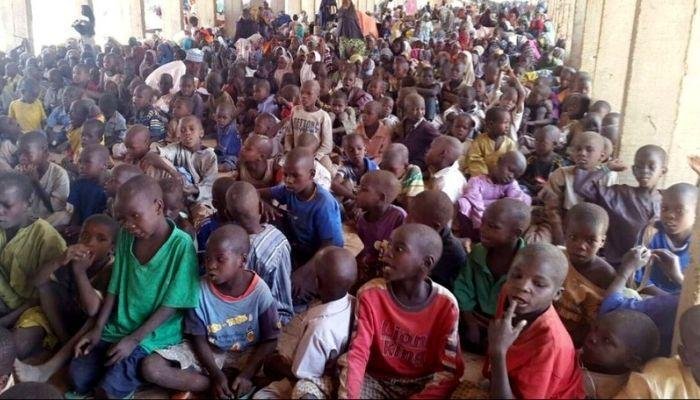
Musa’s experience is one of many stories emerging from Kaduna, where thousands of children who have never attended school or have dropped out are being reached through alternative education pathways.
The scale of the challenge is significant.
The 2025/2026 Kaduna State Out-of-School Children Mapping Report identified 187,719 children aged six to 17 who were out of school across the state’s 23 Local Government Areas.
The exercise covered 360,319 households and found that 106,353 of the affected children were boys and 81,366 were girls.
While 60.2 per cent had never enrolled in school, 39.8 per cent had dropped out.
Poverty emerged as the biggest driver, accounting for 58.5 per cent of cases.
Angai said some families were forced to send children to farms, markets or other forms of work because they could not meet their basic needs.
Gender expectations also play a role. Boys in some communities are expected to contribute economically, while girls may face early marriage and other social pressures.
ROOSC has responded with several pathways, including Catch Up Clubs for younger children, ABEP for older learners and integrated literacy and numeracy programmes in Tsangaya centres.
The project has also mobilised traditional rulers, religious leaders, women and youth groups to convince families to keep children in education.
In one case, community intervention helped return a girl to a learning centre after her father took her away to arrange her marriage.
The project has also used radio programmes and community campaigns to reach children affected by distance, insecurity and other barriers.
Kaduna secured $62.8 million for the intervention, which aims to return 100,000 out-of-school children to learning over four years.
Angai said the project exceeded its first-year target of 10,000 by enrolling 15,000 children, while another 20,000 are participating in Catch Up Clubs.
The intervention includes learning materials and uniforms, construction of 102 new schools and renovation of 170 existing facilities, alongside teacher training and attendance monitoring.
Yet the challenge extends beyond getting children into classrooms.
Migration, child labour, early marriage, poverty and insecurity can pull them back out.
For this reason, the Kaduna State Ministry of Education plans to use the mapping data to guide future education planning, while monitoring systems developed by ROOSC are expected to transition to the ministry.
For Musa, however, the numbers tell only part of the story.
A child who once spent his days on the street now attends school and talks about becoming a doctor.
His journey is unfinished, but his direction has changed.
And in Kaduna, stakeholders are hoping that thousands of other children can be given the same opportunity to turn a second chance at education into a permanent future.
Ezeana Emmanuel