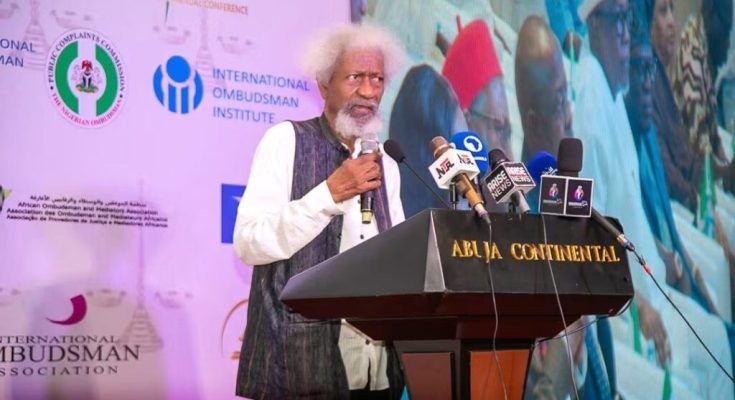
Nobel laureate Professor Wole Soyinka has urged the Public Complaints Commission (PCC) to prioritise the enforcement of court judgments, warning that persistent disobedience by government agencies continues to deny Nigerians the benefits of justice.
Soyinka raised the concern on Thursday during the inaugural Nigerian Ombudsman Annual Conference in Abuja, where he described the failure to implement judicial decisions as a major weakness in the country’s justice system.
Speaking at the event themed “System Building and Compliance: A Key Factor to Good Governance,” the literary icon said resolving the problem would represent a significant achievement.
“If you can solve that for me, believe me, I will die happy,” he declared.
Soyinka questioned why citizens who successfully pursued legal action sometimes waited years for government institutions to obey court orders.
He noted that some individuals had died before receiving the remedies granted to them by competent courts.
The Nobel laureate cited instances involving the delayed return of confiscated passports, describing judgments implemented after prolonged suffering as “medicine after death.”
He challenged the PCC to bridge the gap between judicial pronouncements and their practical enforcement, arguing that compliance was essential to restoring public confidence.
Supporting his position, the Emir of Lafia and retired Supreme Court Justice, Sidi Bage Muhammad I, attributed the problem to indiscipline and failures of leadership.
Bage maintained that public officials should not require repeated reminders before obeying legally binding judgments.
He urged political leaders to demonstrate respect for judicial authority by complying with court decisions.
Meanwhile, PCC Chief Commissioner Bashir Abubakar disclosed that the Commission received 1,281,984 complaints within two years, resolving 716,688.
The figures indicate that 565,296 complaints remained unresolved within the reported totals, although their individual statuses were not specified.
Abubakar described the conference as a milestone in the Commission’s 51-year history and emphasised the importance of building institutions capable of delivering administrative justice consistently.
He highlighted reforms involving staff verification, salary implementation, budgetary improvements and the establishment of additional directorates.
Former Commonwealth Secretary-General Emeka Anyaoku called for greater public awareness of the Commission’s services, noting that many Nigerians remained unfamiliar with avenues for challenging administrative injustice.
He identified unpaid pensions, gratuities and inadequate medical services among problems for which citizens could seek intervention.
Secretary to the Government of the Federation George Akume, represented by Permanent Secretary Augusta Beke, described public complaints as useful indicators of institutional weaknesses.
Akume stressed that effective governance required transparent procedures, competent personnel and consistent compliance with established rules.
Similarly, Senate Committee Chairman on Ethics, Privileges and Public Petitions, Neda Imasuen, advocated stronger institutions rather than systems dependent on individual officeholders.
He warned that laws and policies would achieve little if officials could disregard them without consequences.
Participants were consequently urged to develop practical recommendations for strengthening accountability, improving compliance monitoring and making administrative justice more accessible to Nigerians.
Ezeana Emmanuel