

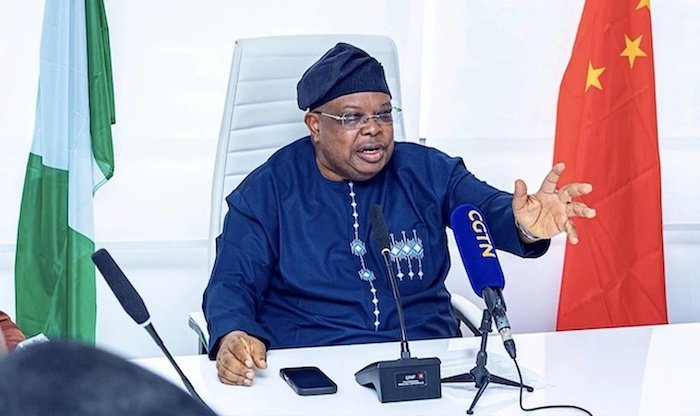
Roughly N10 trillion in public funds has either been squandered or swallowed up somewhere within Nigeria’s electricity value chain over the years, a staggering figure that frames the scale of the challenge now facing Power Minister Joseph Tegbe as he attempts to reset a sector he says has carried the same structural weaknesses for more than four decades.
Tegbe laid out a multi-pronged recovery plan built around a technical audit of the national transmission network, harmonised federal and state electricity regulations, a grid stabilisation program, efforts to restore sector liquidity, strategic asset centralisation, and a long-term super grid initiative. He struck an optimistic tone about the timeline for results. “Within the next two to three years, Nigerians should experience a stronger grid, reduced technical losses, improved market discipline, greater investor confidence, expanded electricity access and significantly higher operational capacity,” he said.
A Financial review of the sector’s finances since the November 2013 privatisation found power generation has hovered around a 4,500 megawatt average, far short of both the 20,000MW government target and the 30,000MW analysts say the country actually needs. The money poured into the sector over that period is substantial: the Central Bank’s N213 billion Nigerian Electricity Market Stabilisation Facility, a N701 billion Payment Assurance Guarantee for generation companies, over N200 billion under the National Mass Metering Programme, N700 billion through the Presidential Metering Initiative, the €2.3 billion Siemens Presidential Power Initiative, more than $2.4 billion in World Bank and African Development Bank-backed projects, and most recently the N4 trillion Presidential Power Sector Debt Reduction Programme. Despite all of it, NERC’s latest data shows average available generation capacity across 28 grid-connected plants stood at just 4,457.96MW in the first quarter of 2026, with actual hourly generation even lower at 4,112.72MW, well short of the government’s own 6,000MW target.
The sector’s cash crunch has only deepened alongside the weak output. The Association of Power Generation Companies says unpaid subsidy obligations have climbed to N6.2 trillion, split between N4 trillion accumulated from 2015 to 2024 and a further N2.2 trillion added in 2025 alone. The federal government disputes that figure sharply. Finance Minister Taiwo Oyedele says a detailed reconciliation exercise, checked line by line against invoices and services rendered, brought verified liabilities down from roughly N4 trillion to about N3.3 trillion. APGC Executive Director Dr Joy Ogaji rejected that process outright, arguing generation companies were never actually consulted. “We have asked them to publish how they arrived at the N3.3 trillion. We are owing gas suppliers about N4 trillion. If government owes us only N3.3 trillion, it raises many questions,” she said, questioning how GenCos would even cover operating costs if the lower figure holds. Separate data from Nigerian Bulk Electricity Trading shows the scale of the shortfall in real terms: between April 2025 and April 2026, the government received subsidy invoices worth N1.859 trillion but paid out only N76.95 billion, leaving roughly N1.78 trillion outstanding.
To chip away at that backlog, the government has turned to the domestic bond market. Around N333 billion has already been paid to generation companies under the debt reduction programme, and a fresh N729 billion bond, the second series under the broader N4 trillion initiative, was recently unveiled at an NBET investors’ forum in Abuja, following an earlier N501.02 billion issuance. Officials describe the bond strategy as central to restoring liquidity and investor confidence across the industry.
Not everyone agrees the debt figures reflect the sector’s true condition. Kunle Olubiyo, President of the Nigeria Consumer Protection Network, argued that continued government involvement in the market has itself created room for inflated claims and hidden leakages. “As much as government is desirous of injecting money, there is a value chain of beneficiaries of leakages and wastages. Because government bears the burden, a lot of claims thrown into the electricity pool are virtually non-existent or have been orchestrated to create a desired end,” he said, calling for full privatisation, including divestment from distribution companies and the unbundling of the Transmission Company of Nigeria, to force greater efficiency. Engr. Israel Abraham, President of the Chartered Institute of Power Engineers of Nigeria, placed the blame elsewhere, arguing the sector has suffered from non-technical leadership in critical roles. “The electricity industry is highly technical. Progress has stalled because the right people have not been allowed to manage the sector. Until competent professionals are put in charge, the industry will continue to struggle,” he said.
For his part, Tegbe insists the narrative is already shifting. He credited President Bola Tinubu with what he called unmatched political commitment to reform, pointing to the continued implementation of the Electricity Act and the decentralisation of the market to allow states to develop electricity systems suited to their own economic realities. Among the concrete steps he cited: the inauguration of a 5,000-strong “Power Force” of young Nigerians deployed for meter installation nationwide, progress on long-standing meter procurement bottlenecks, and generation levels that have held steady at 5,000MW over the past two weeks.
Even so, Tegbe was careful not to overstate the sector’s trajectory. “We are under no illusion. Generation alone does not solve Nigeria’s electricity problem. Electricity must be generated, transmitted, distributed and paid for. All these components must function simultaneously,” he said, describing challenges that span generation, transmission, distribution, regulation, governance, and liquidity alike. His response is a sector-wide plan anchored in the transmission audit, regulatory harmonisation between federal and state authorities, targeted grid stabilisation investment along three key corridors, Lagos, Enugu-Port Harcourt, and Abuja-Kaduna-Kano, continued rollout of smart metering to curb collection losses, and the long-term Super Grid Programme aimed at expanding the country’s transmission backbone to support future industrial growth.