


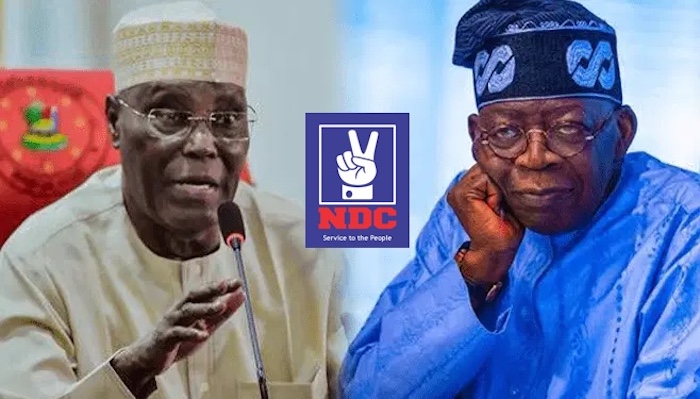
Atiku Abubakar has accused President Bola Tinubu of working to eliminate meaningful opposition ahead of the 2027 elections, responding to a Federal High Court ruling that set aside an earlier judgment directing INEC to register the Nigeria Democratic Congress as a political party.
The ruling, delivered by Justice Isah Dashen in Lokoja, Kogi State, vacated a December 2025 judgment on the grounds that the Peace Movement Party, whose interests were affected by the case, had not been joined as a party to the suit. The technical basis for the ruling did not soften Atiku’s interpretation of its consequences. In a statement issued by his media office, the former Vice President described the development as part of a coordinated effort to cripple opposition parties in advance of Tinubu’s 2027 re-election bid.
Atiku said he was not surprised by the ruling, framing it as consistent with what he described as the Tinubu administration’s pattern of conduct toward political competition. He accused the president of projecting democratic credentials while deploying agents to undermine the conditions that make democracy functional. His language was direct: a leader genuinely confident in his popularity and policies, he argued, would have no reason to fear free and fair competition.
The historical comparisons Atiku reached for were pointed. He invoked Muhammadu Buhari, a former military ruler, as a more defensible democrat on this specific question, noting that Buhari’s administration did not move to deregister opposition parties despite its many other controversies. He also cited Goodluck Jonathan’s oft-quoted position that no political ambition is worth the blood of any citizen. The implicit argument was that Tinubu, who built his political reputation partly on opposition to military-era governance, was now behaving in ways that compared unfavourably to the very figures his supporters once contrasted him against.
Atiku directed a separate warning at the judiciary, urging judges to resist pressure from politicians seeking to use the courts as instruments of political suppression. He described the judiciary as the last hope of the masses and cautioned that its credibility, once compromised, could not easily be restored. The framing was a public appeal but also a pressure campaign: judges handling politically sensitive cases were being told, by a prominent national figure, that history and public trust were watching.
The NDC’s leadership, including National Leader Seriake Dickson and vice-presidential candidate Rabiu Musa Kwankwaso, have separately expressed confidence that the party will prevail through the legal process. Atiku’s intervention adds external weight to that position while broadening the frame from a single party’s registration dispute to a systemic argument about the health of Nigerian democracy ahead of 2027.
Whether the courts ultimately resolve the NDC matter on its legal merits or in a manner that feeds the political narrative Atiku is constructing, the opposition’s message for the next eighteen months is now clearly taking shape: this is a contest between a ruling party trying to clear the field and an opposition trying to keep it open.