


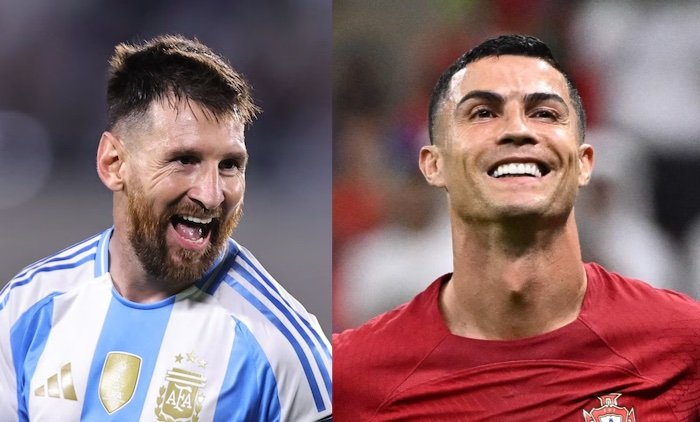
For nearly twenty years, football has revolved around a single argument. It has been debated in stadiums, barbershops, living rooms and across every corner of social media. Cristiano Ronaldo or Lionel Messi? The question has transcended generations, divided friendships and shaped an era unlike any the sport has ever seen. That argument has now played out its final act on the sport’s biggest stage, and the 2026 World Cup gave both men an ending that felt, in its own way, entirely in character.
Cristiano Ronaldo and Lionel Messi arrived at the pinnacle of football by remarkably different routes. One built his legacy through relentless self improvement and an insatiable desire to conquer every challenge placed before him. The other appeared to bend the game to his will with a level of natural genius rarely witnessed in any sport. This summer, across stadiums in Canada, Mexico and the United States, both men played their sixth World Cup, a feat shared only with Mexico’s veteran goalkeeper Guillermo Ochoa, who bowed out of international football once the tournament ended.
Messi’s Argentina arrived as defending champions, and he wasted no time rewriting the record books. His hat trick in the opening match against Algeria tied Miroslav Klose’s long standing mark of sixteen World Cup goals. Two more against Austria took him past it, and by the time Argentina’s campaign was over he had scored twenty goals across his six tournaments, more than anyone in the competition’s history. He already held the records for most World Cup appearances, most matches played and most minutes on the pitch, marks he had taken from Paolo Maldini in Qatar four years earlier. He was at his creative best in the knockout rounds too, a goal and an assist in a chaotic win over Egypt, then two assists that eliminated England in the semifinals. Argentina reached the final, but this time the story did not end in celebration. Spain beat them to deny Messi a second consecutive title, and whether that defeat marks the true end of his international career remains unconfirmed. He has given himself the option of playing on through the next Copa America before deciding if a farewell at the 2030 World Cup is realistic.
Ronaldo’s tournament carried its own mixture of history and heartbreak. At forty one he became the second oldest player at the finals, behind only Scotland’s Craig Gordon, and he added to his standing as international football’s all time leading scorer by becoming the first man to score in six different World Cups, opening his account against Uzbekistan. He was criticised for going scoreless in a draw with DR Congo, answered with two goals against Uzbekistan and a penalty against Croatia, but Portugal’s run ended in the round of sixteen, beaten one nil by Spain. Ronaldo left the pitch in tears, and he has since confirmed he will not return in 2030, closing out a World Cup career that, for all his goals and records, never delivered the trophy that eluded him at every turn.
The tournament had briefly promised something neither man had ever experienced. Argentina and Portugal sat on opposite sides of the bracket, and for a stretch it looked plausible that Messi and Ronaldo might finally meet in a World Cup, two rivals who had shaped the same era but somehow never shared the same pitch at football’s biggest event. Portugal’s exit in the round of sixteen closed that door for good. The dream final never happened, and it never will now.
If Ronaldo were to retire today, his place in football history would be secure, not merely as one of the greatest goalscorers the game has produced, but as the embodiment of ambition itself. From his early days at Sporting Lisbon to his rise at Manchester United and his dominance at Real Madrid, he transformed himself repeatedly, evolving from a dazzling winger reliant on stepovers and pace into a ruthless forward capable of deciding matches with a single touch. Five Ballon d’Or awards, five Champions League titles and scoring records that may stand for decades sit alongside what he gave Portugal, a first major trophy at Euro 2016 and a UEFA Nations League three years later. His greatest contribution may still be the standard he set for professionalism, a devotion to conditioning and preparation that stretched his career years beyond when most players begin to fade. That same intensity has always cut both ways, and his visible frustration on the pitch, his uncompromising personality and the weight of expectation that followed him raised familiar questions in his final World Cup appearances about whether his towering presence had become both a blessing and a burden for the teams around him.
Messi occupies an altogether different place in the sport’s imagination. Where Ronaldo conquered through power and persistence, Messi captivated through elegance, intelligence and creativity. At Barcelona he became the centerpiece of one of the greatest club sides in history, collecting league titles, Champions League trophies and individual honours at an unprecedented rate, and his record eight Ballon d’Or awards reflect a career built on consistency as much as brilliance. His legacy always extended beyond silverware, an ability to manipulate space and time that reduced defenders to spectators and made matches unfold at his own pace. For years one criticism lingered, whether he could replicate his club dominance with Argentina, and the answer arrived emphatically with the 2022 World Cup and the sustained excellence he showed again this year, even in defeat.
Perhaps the true significance of Ronaldo and Messi was never in their differences but in what they achieved by existing at the same time, pushing one another to heights that neither may have reached alone, turning excellence into expectation and shattering records once considered untouchable. Ronaldo became the symbol of relentless work, discipline and self belief. Messi emerged as the face of imagination, instinct and effortless brilliance. Neither lifted the trophy this time, and the meeting football wanted most never came together. But long after both men have left the pitch for good, the sport will remember that it was privileged enough to watch them share an era, and that even in their final World Cup, they still found ways to make history.