The Federal Government has defended its decision to realign sections of the Lagos-Calabar Coastal Highway, citing flooding and climate-related concerns, as legal and civil society voices question the implications for communities along Nigeria’s Atlantic coastline.
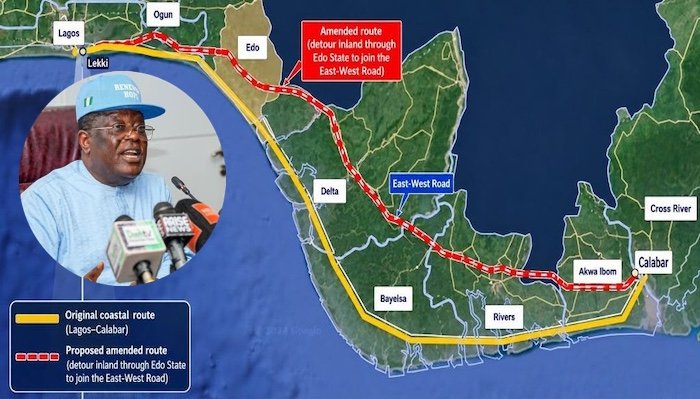
Minister of Works David Umahi said President Bola Tinubu had approved the use of the existing East-West Road for the stretch running from the Ondo State boundary into Edo State, instead of proceeding with the proposed coastal alignment.
Umahi put the affected corridor at approximately 104 kilometres, including a proposed 45-kilometre bypass. He said parts of the existing road would need to be raised by about two metres to address flooding risks.
The minister maintained that the decisions concerning the Ondo section were based on engineering considerations and said the government had no regret over the changes.
However, the revised route has drawn questions about how the project will serve coastal settlements and economic activities that depend on access to the Atlantic coastline.
Senior Advocate of Nigeria Ebun-Olu Adegboruwa called on Tinubu to direct the Ministry of Works to explain the approved route and identify the coastal communities that would benefit from the highway or be bypassed by the realignment.
Adegboruwa argued that moving parts of the project inland could affect its original objective of connecting communities and economic centres along the coast. He specifically raised concerns about Ilaje and other coastal settlements in Ondo and Delta states, where fishing and transportation are important economic activities.
The Human Rights Writers Association of Nigeria (HURIWA) also questioned why flooding and climate-related risks were now being cited as major reasons for changing the route. The group called for accountability over the approval of the original design and the decisions that led to the realignment.
Former Vice President Atiku Abubakar separately alleged that pressure was being mounted on the National Assembly to approve a loan of up to $20 billion linked to payments for the coastal highway. He called for the disclosure of relevant project details.
These concerns have placed attention on the need for clear explanations of the engineering decisions, project financing and the communities expected to benefit from the road.
Meanwhile, Umahi provided an update on construction progress. He said pavement work on Section Two, covering 55 kilometres, was expected to be completed by November, with construction progressing from both the Lagos and Calabar ends.
According to the minister, more than 40 per cent of the relevant section at the Calabar end had been completed. He also reported that Section Five in Akwa Ibom State had recorded more than 20 per cent progress within three months.
The competing positions highlight two central issues: the government’s stated need to respond to environmental and engineering risks, and concerns about the highway’s intended coastal connections, community access and financial transparency.
Further public disclosure of the approved route, technical assessments and project details would help clarify the basis for the changes and their implications for affected communities.