

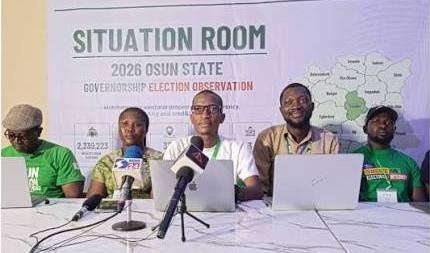
Roughly a million registered voters in Osun State collected their Permanent Voter Cards but never showed up to cast a ballot on Saturday. That gap is what ActionAid Nigeria and The Abuja School of Social and Political Thought chose to highlight first at a joint press conference in Abuja on Monday, even as their sharpest demand centered on something more specific: an investigation into alleged incitement to violence attributed to Senator Francis Fadahunsi.
The two organizations, represented by ActionAid’s Country Director Dr Andrew Mamedu and the Abuja School’s Director Dr Sam Amadi, opened by crediting Osun voters for a largely peaceful election and praising INEC’s handling of the process. But they were direct in tying the unused PVCs to a climate of intimidation in the run-up to the vote, suggesting that violence and inflammatory rhetoric likely discouraged some voters from turning out at all.
At the center of that concern is a statement reportedly delivered in Yoruba and attributed to Fadahunsi, who represents Osun East Senatorial District. According to the CSOs, he allegedly directed supporters to seek out and attack members of the Accord Party they encountered, including ordinary voters. They noted with particular alarm that the statement was reportedly made with an instruction that it be recorded, a detail they said would deepen the seriousness of the allegation if confirmed.
“That a Senator of the Federal Republic of Nigeria could publicly make a statement encouraging violence against political opponents raises serious concerns about the growing normalisation of violent rhetoric in our politics,” the groups said, arguing that police involvement so far hasn’t gone far enough. They acknowledged that Fadahunsi had been interviewed by police but insisted that step alone was insufficient, calling for a full investigation and formal charges if evidence supports them.
The organizations framed the case as a test of whether Nigeria’s law enforcement can break a longer pattern. Repeated failure to prosecute electoral offenses, they argued, creates incentives for political actors to keep using threats and violence as tools for winning power, undermining public trust in elections over time. They called on the Inspector-General of Police to keep the investigation transparent and free of political interference, and urged the Attorney-General to apply the law without favoring any side.
That last point mattered to them specifically. The groups were careful to note that Fadahunsi isn’t the only political figure whose rhetoric has raised alarm, and that similar patterns have surfaced across party lines. Addressing it selectively, they argued, would defeat the purpose, with the 2027 general elections now serving as the real stakes behind the demand.