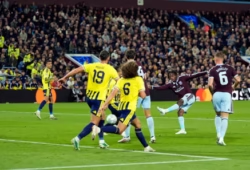



Mohamed Salah scored the goal that broke New Zealand’s resistance at the 2026 World Cup on Sunday. Few will remember how temporary that resistance became before he did.
Egypt and New Zealand were level at 1-1 in the 58th minute when New Zealand substitute Ben Old, introduced to help his side protect a hard-earned foothold in the contest, tore his shorts following a challenge near the Egypt penalty area. Under football’s Laws of the Game, he had no choice. He left the field to change. Play continued. Moments later, Salah scored. New Zealand had been reduced to ten men not by a red card, not by injury, but by a wardrobe malfunction at the worst possible moment.
Egypt won 3-1 and are currently top Group G. Their goal was legal. And that, precisely, is the problem worth discussing.
Under IFAB Law 4, a player whose kit becomes torn or non-compliant must leave the field of play to correct it. The referee is not required to stop play. There is no provision in the laws for pausing the match because a team has been involuntarily reduced through a kit issue. VAR, for all its reach into the modern game, is not designed to review goals scored against a team temporarily disadvantaged by a compulsory equipment change. It reviews offside, handball, and foul play but an unlucky tear in a pair of shorts falls outside its jurisdiction entirely.
This is a structural gap because a player who receives a red card reduces his team through an act of misconduct. A player who goes down injured reduces his team, but referees routinely stop play for serious injuries. Ben Old reduced his team through neither misconduct nor injury. His shorts tore and in the events that followed, his team conceded a goal.
This is not to discredit the goal from Egypt. Salah took his chance, as he has done his entire career, and his side deserved their victory across the full ninety minutes. New Zealand’s evening was already unravelling before Old’s shorts became the story. Trezeguet’s late finish confirmed that the result reflected the balance of play.
But football has spent the better part of a decade expanding VAR’s scope to ensure that goals are not scored through deception or error. The Ben Old incident presents a different category of injustice which is that of a goal scored within the letter of the law, against a team disadvantaged through no fault of their own, in a situation the rulebook never anticipated needing to address.
The question for IFAB and FIFA is a simple one. When a player is forced off the field by an involuntary kit failure in an attacking phase of play, should the referee have discretion to delay the restart? The laws currently say no. Sunday night in Miami offered a reasonable case for revisiting that answer.
New Zealand exit the group stage with one point and no path forward. Ben Old will change his shorts and move on. The rule that sent him off the pitch, however, is now harder to ignore.