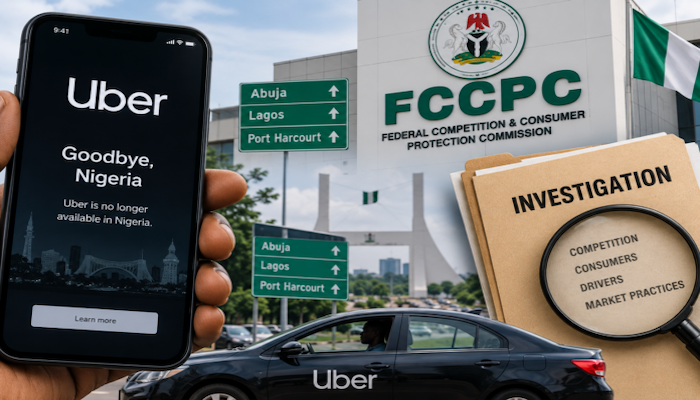
The sudden departure of Uber from Nigeria has drawn the attention of the country’s consumer protection regulator, which is now examining what the company’s withdrawal means for customers.
The Federal Competition and Consumer Protection Commission (FCCPC) is investigating whether Uber fulfilled its obligations to Nigerian users before bringing its operations to an end.
FCCPC Chief Executive Officer Tunji Bello told Bloomberg on Sunday that the commission was particularly interested in finding out whether any customers had paid for services that were subsequently not provided because of the company’s exit.
The probe introduces a new dimension to Uber’s withdrawal, shifting attention from the company’s business decision to the potential consequences for consumers.
Uber announced on September 2 that it was leaving both Nigeria and Uganda, bringing its operations in the two markets to an immediate close. The company described the move as the outcome of a review of its business and stressed that it was not a withdrawal from Africa as a whole.
The decision has also changed the competitive landscape of Nigeria’s ride-hailing industry. With Uber no longer available, rival platforms such as Bolt and inDrive are seeking to strengthen their positions and win over users who previously relied on the service.
For the FCCPC, however, the immediate question is not which competitor will gain the most from Uber’s departure. The regulator wants to establish whether consumers were adequately protected during the transition and whether any outstanding obligations remained when the platform shut down its Nigerian operations.
The investigation could therefore have implications beyond the ride-hailing sector. As digital businesses become increasingly important to Nigerian consumers, companies withdrawing from a market may face greater scrutiny over how they handle customers, payments and services that are still outstanding.
Uber’s exit has already created uncertainty for users and opportunities for its competitors. The FCCPC’s intervention now places the manner in which the withdrawal was carried out under regulatory examination.
The commission is expected to establish whether Uber’s decision and the process used to end its Nigerian operations complied with existing consumer protection requirements.
Meanwhile, the country’s ride-hailing market is adjusting to the absence of one of its biggest international operators, with competing platforms positioning themselves to capture the customers and market share left behind by Uber.