


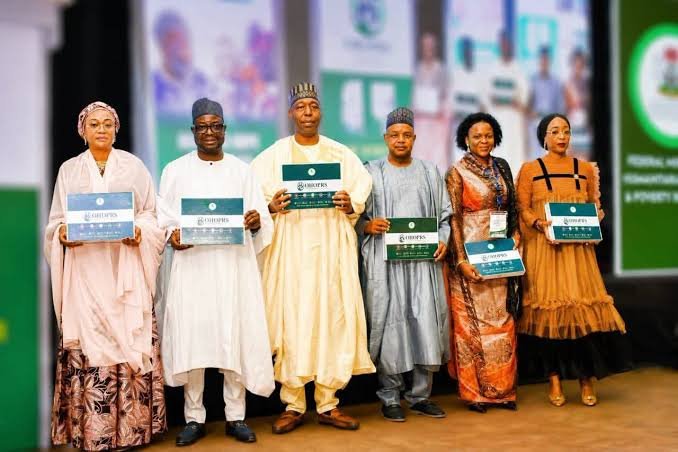
The Federal Government has launched a $1 billion social protection programme aimed at helping vulnerable Nigerians move beyond temporary relief and towards sustainable livelihoods and economic independence.
The Household Prosperity and Empowerment Social Protection Project (HOPE-SP) was unveiled on Wednesday at the State House Banquet Hall in Abuja as part of a broader effort to overhaul the country’s approach to humanitarian assistance and poverty reduction.
The launch also featured four other initiatives: the One-Humanitarian-One Poverty Response System (OHOPRS), Emergency Cash Transfer Programme, Federal Ministry of Humanitarian Affairs and Poverty Reduction Ministerial Blueprint, and Humanity First Magazine.
First Lady Oluremi Tinubu, who delivered the keynote address, said the initiatives were designed to complement the government’s ongoing economic reforms by ensuring that vulnerable households are not left behind.
Speaking on the theme, “From Palliatives to Pathways,” she said many families continued to require assistance despite measures being implemented by the President Bola Tinubu administration to strengthen the economy.
She described HOPE-SP as a shift from simply providing temporary assistance to identifying the specific needs of vulnerable households and placing them on a pathway towards recovery, empowerment and self-reliance.
Minister of Humanitarian Affairs and Poverty Reduction, Bernard Doro, said the programme represented a new national architecture for social protection, with government moving from reactive relief to anticipatory intervention and poverty reduction.
Doro identified fragmentation among existing government programmes as a major challenge, saying different agencies often operated separate databases and interventions. This, he noted, sometimes resulted in duplication, with some households receiving multiple forms of assistance while others were left out.
Under the new framework, the government plans to focus on households rather than individual programmes. Beneficiaries will be identified, assessed and tracked through what the minister described as a “poverty graduation pathway” towards economic inclusion and self-reliance.
The OHOPRS will serve as a unified platform for humanitarian and poverty-reduction interventions, integrating existing databases with the National Social Register, which currently contains about 20 million households.
Doro also announced plans to establish a National Poverty Intelligence Lab and said the success of social intervention programmes would be measured by how many households are protected, economically included and eventually lifted out of poverty.
Minister of Budget and Economic Planning, Atiku Bagudu, stressed that effective social protection required coordination across federal, state and local governments.
He said the administration’s ambition to build a $1 trillion economy by 2030 must be matched by efforts to ensure economic opportunities reach Nigerians at the grassroots.
Borno State Governor Babagana Zulum also welcomed the initiative, stressing that sustainable security required addressing poverty and inequality alongside immediate humanitarian needs.