

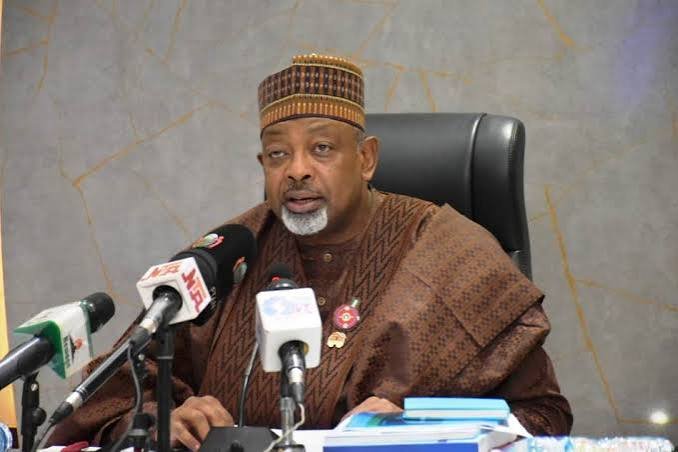
Speaking at the National Policy Dialogue on Agricultural Mechanisation in Abuja, the Minister of Agriculture and Food Security, Senator Abubakar Kyari, said the policy would provide a sustainable framework for agricultural mechanisation, while the investment strategy would create bankable opportunities for investors and reduce dependence on government-funded interventions.
The Federal Government has unveiled the National Agricultural Mechanisation Policy and Investment Strategy aimed at transforming Nigeria’s agricultural sector through increased mechanisation, local production and private-sector investment.
Kyari disclosed that the strategy includes plans for a mega tractor assembly plant capable of producing between 2,000 and 4,000 units annually to reduce import dependence and strengthen local manufacturing capacity.
According to him, the initiative aligns with the Renewed Hope National Agricultural Mechanisation Programme, which seeks not only to increase access to machinery but also to ensure that agricultural equipment remains productive, accessible and properly maintained.
The minister urged investors, youths and women to take advantage of opportunities within the mechanisation ecosystem, describing agriculture as a growing sector driven by technology, innovation and wealth creation.
He commended Borno State Governor Babagana Zulum for supporting farmers through fertiliser distribution and irrigation projects, while also praising TracTrac Mechanisation Service Limited for training young Nigerians and supporting smallholder farmers with mechanisation services.
Governor Zulum described the programme as a major step towards achieving food security and economic growth, while Minister of State for Agriculture and Food Security, Senator Aliyu Sabi Abdullahi, said the initiative would improve farmers’ livelihoods and increase food production.
Permanent Secretary of the ministry, Dr Marcus Ogunbiyi, noted that mechanisation now extends beyond tractors and equipment, stressing its importance to food security, youth employment, women’s empowerment and national competitiveness.