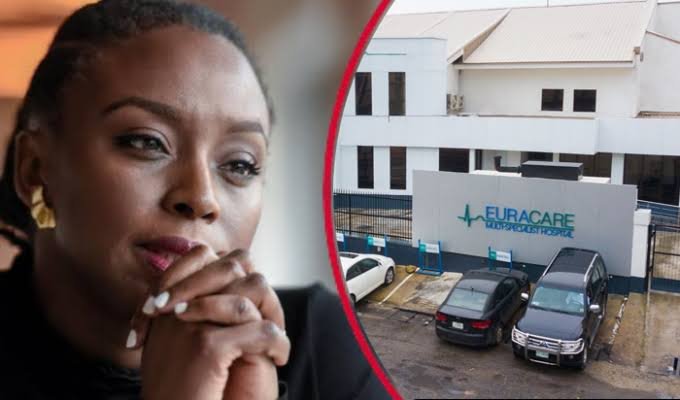
The Lagos State High Court sitting in Ikoyi will on October 12, 2026, rule on an application by Eurapharma Care Services Nigeria Limited, operators of Euracare Multi-Specialist Hospital, seeking to stop the coroner’s inquest into the death of Nkanu, son of Nigerian author Chimamanda Adichie.
Justice Aishat Opesanwo fixed the date after hearing arguments from Euracare, the Lagos State Government and Nkanu’s family over whether the coroner has the authority to continue the investigation following the cremation of the deceased’s body.
Euracare’s counsel, Prof Taiwo Osipitan (SAN), argued that the cremation raised fundamental questions about the coroner’s jurisdiction because a post-mortem examination could no longer be carried out.
Relying on Sections 14 and 15 of the Lagos State Coroners System Law, Osipitan argued that determining the identity of a deceased person, the circumstances surrounding the death and its cause ordinarily involved an examination of the body.
He told the court that the Chief Pathologist of Lagos State neither conducted a post-mortem examination nor authorised the cremation. He therefore argued that proceeding without the body could make any conclusion about the cause of death speculative.
The hospital is also challenging the manner in which evidence is expected to be presented. Osipitan argued that although a coroner’s inquest is inquisitorial rather than a criminal trial, allegations of medical negligence had effectively made the proceedings accusatorial in substance.
He further objected to an arrangement that would require the hospital and its personnel to present evidence before the deceased’s family had set out its allegations, arguing that this could affect the hospital’s right to a fair hearing.
The Lagos State Attorney-General and Commissioner for Justice, Lawal Pedro (SAN), opposed the application and urged the court to allow the inquest to proceed.
Pedro relied on Section 21 of the Coroners System Law, arguing that the legislation gives a coroner the discretion to conduct an investigation even when a deceased person’s body is unavailable or has been destroyed.
He also described Euracare’s application as premature, arguing that the coroner had not yet taken evidence when the hospital approached the High Court.
Counsel to Nkanu’s family, Kemi Pinheiro (SAN), similarly urged the court to dismiss the application. He argued that the cremation did not deprive the coroner of jurisdiction and cited Sections 21 and 31(1) of the law in support.
Pinheiro maintained that an inquest is a fact-finding process and not a criminal trial, with the coroner’s findings capable of being forwarded to relevant authorities if further action is considered necessary.
Nkanu died on January 7, 2026, at Euracare Multi-Specialist Hospital in Lagos. His parents, Chimamanda Adichie and Dr Ivara Esege, have alleged breaches of duty of care in the treatment of their son.
Euracare has denied the allegations of medical negligence, describing them as inaccurate and unfounded.
The court will determine the hospital’s application on October 12.