

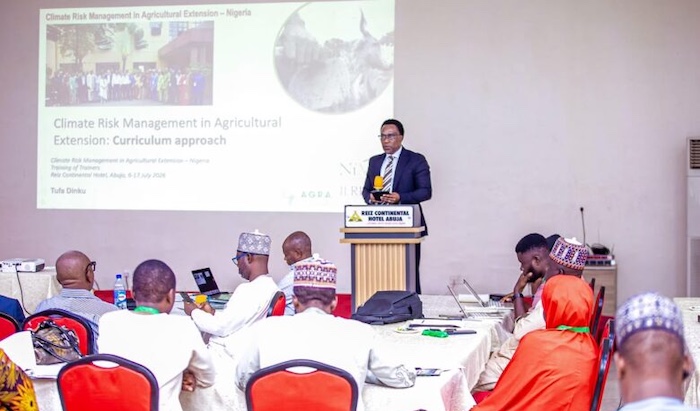
The gap between what weather scientists know and what farmers actually receive is the problem a new training programme in Abuja is trying to close. The Nigerian Meteorological Agency and the International Livestock Research Institute have kicked off a 10-day Training of Trainers workshop on Climate Risk Management in Agricultural Extension, built around a simple premise: climate data only helps farmers if someone translates it into advice they can act on.
That translation role falls to extension officers, and NiMet Director-General Prof. Charles Anosike used Monday’s opening ceremony to make the case for why they matter so much. He described them as the link between climate science and the practical decisions farmers make every season, when to plant, which crops to grow, how to manage water and soil, what inputs to use, and how to prepare for hazards before they strike. With farmers already contending with irregular rainfall, dry spells, heat stress, flooding and pests, Anosike said the stakes attached to getting that translation right, for agricultural productivity, food security and rural livelihoods, have only grown.
The workshop itself is part of a broader AGRA target-countries initiative aimed at strengthening digital climate advisory services and building resilient agricultural systems across Africa. Its logic is one of multiplication rather than direct outreach, training a group of trainers who can then carry the material to a far wider network. “Training trainers will multiply the quality, reach and impact of climate services across Nigeria’s agricultural landscape,” Anosike said, describing the Nigeria-adapted CRMAE curriculum as designed specifically to help extension and advisory providers weave climate services into their existing support for smallholder farmers. He asked participants to treat the sessions as a starting point, sharing what they learn and building networks that extend into farmer groups, cooperatives and rural communities long after the workshop ends, and thanked the partners and institutions backing the effort.
Two of those partners added their own perspective at the opening. Dr Kelvin Shikuku of ILRI commended Anosike for hosting the workshop and pointed to NiMet’s broader track record in building out climate services nationally. Dr Tufa Dinku of the Stockholm Environment Institute, serving as lead facilitator, went a step further, confirming that NiMet, under Anosike, would take charge of rolling the CRMAE curriculum out fully across the country once the training concludes.