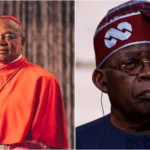


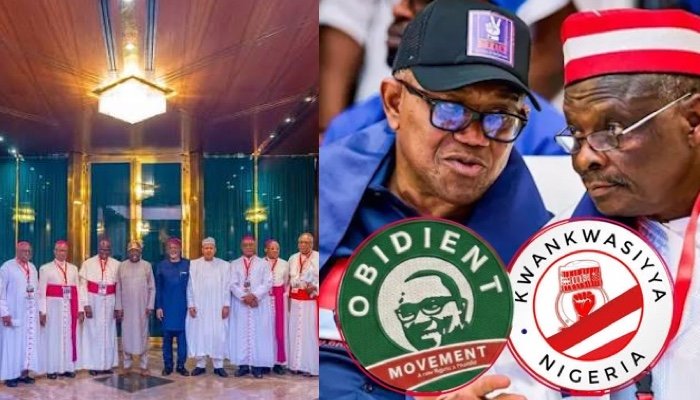
Nigeria Democratic Congress presidential candidate Peter Obi and his running mate Rabiu Musa Kwankwaso have thrown their weight behind the Catholic Bishops’ Conference of Nigeria and Cardinal John Onaiyekan, pushing back against what they characterize as a troubling pattern of government hostility toward religious leaders who speak candidly about the country’s problems.
The controversy stems from the Presidency’s recent criticism of Onaiyekan, accusing him of publicly disclosing details from a closed-door meeting between President Bola Tinubu and Catholic bishops. In a statement titled “When a Government Declares War on the Truth,” Obi warned that targeting religious leaders for raising national concerns risks weakening democratic accountability and diverting attention from the country’s actual problems. He argued that Nigeria’s deepening economic hardship, insecurity, inflation, and unemployment demand genuine engagement with criticism rather than defensive pushback against those voicing it.
Obi was careful to frame the CBCN’s intervention as consistent with its historical role rather than a departure from it, noting the conference has never functioned as a political opposition but has instead served as a moral voice on issues of common concern across both military and civilian administrations. He pointed out that similar concerns have been raised by other major religious bodies as well, including Jama’atu Nasril Islam, the Supreme Council for Shari’ah in Nigeria, the Christian Association of Nigeria, and the Nigerian Supreme Council for Islamic Affairs, all of which have flagged rising insecurity and economic hardship in their own right. He argued religious leaders are often uniquely positioned to witness such struggles firsthand, given their day-to-day presence within communities grappling with high food prices, unemployment, and insecurity.
Drawing on his own experience as Anambra State governor, Obi said that constructive criticism from traditional rulers and religious figures had directly contributed to successes his administration achieved in education and healthcare. “As leaders, we should be gracious enough to listen to people and organisations that speak the truth to us and genuinely criticise us when things are not going in the right direction,” he said.
To reinforce his point, Obi invoked a historical parallel, recalling that when Pope John Paul II visited Nigeria in 1998 and openly challenged General Sani Abacha over issues including the detention of Chief Moshood Abiola, the pontiff faced no public backlash for doing so. He also flagged what he described as an inconsistency in the government’s posture toward the Catholic Church, noting that Tinubu had shown clear respect for the institution by arriving early and participating fully in Pope Leo XIV’s inauguration ceremonies in Rome, a stance Obi suggested seems to have shifted following the bishops’ recent criticism.
Obi further accused certain political actors of attempting to frame the bishops’ comments as a narrowly Catholic grievance, arguing instead that the issues raised, insecurity, poverty, inflation, unemployment, and widespread hardship, cut across religious and ethnic lines entirely. “The bishops merely expressed what millions of Nigerians experience daily,” he said, urging officials to address the substance of the concerns rather than attacking the messengers. “A democratic government should welcome honest feedback from credible institutions.”
Kwankwaso echoed that sentiment in a post on his verified X account, praising the bishops for what he called their courage and patriotism and rejecting any suggestion that their comments were politically motivated. He argued the concerns raised reflect the everyday reality facing ordinary Nigerians nationwide, lamenting that despite the country’s considerable human and natural resources, millions continue to struggle with unemployment, insecurity, and shrinking access to quality education and healthcare. “I commend the Catholic Bishops for their courage and patriotism. It is through such collective commitment and responsible leadership we can build a more peaceful, united and prosperous Nigeria,” Kwankwaso wrote, calling on Nigerians to keep engaging government constructively while urging leaders to prioritize citizens’ welfare and security above other considerations.