

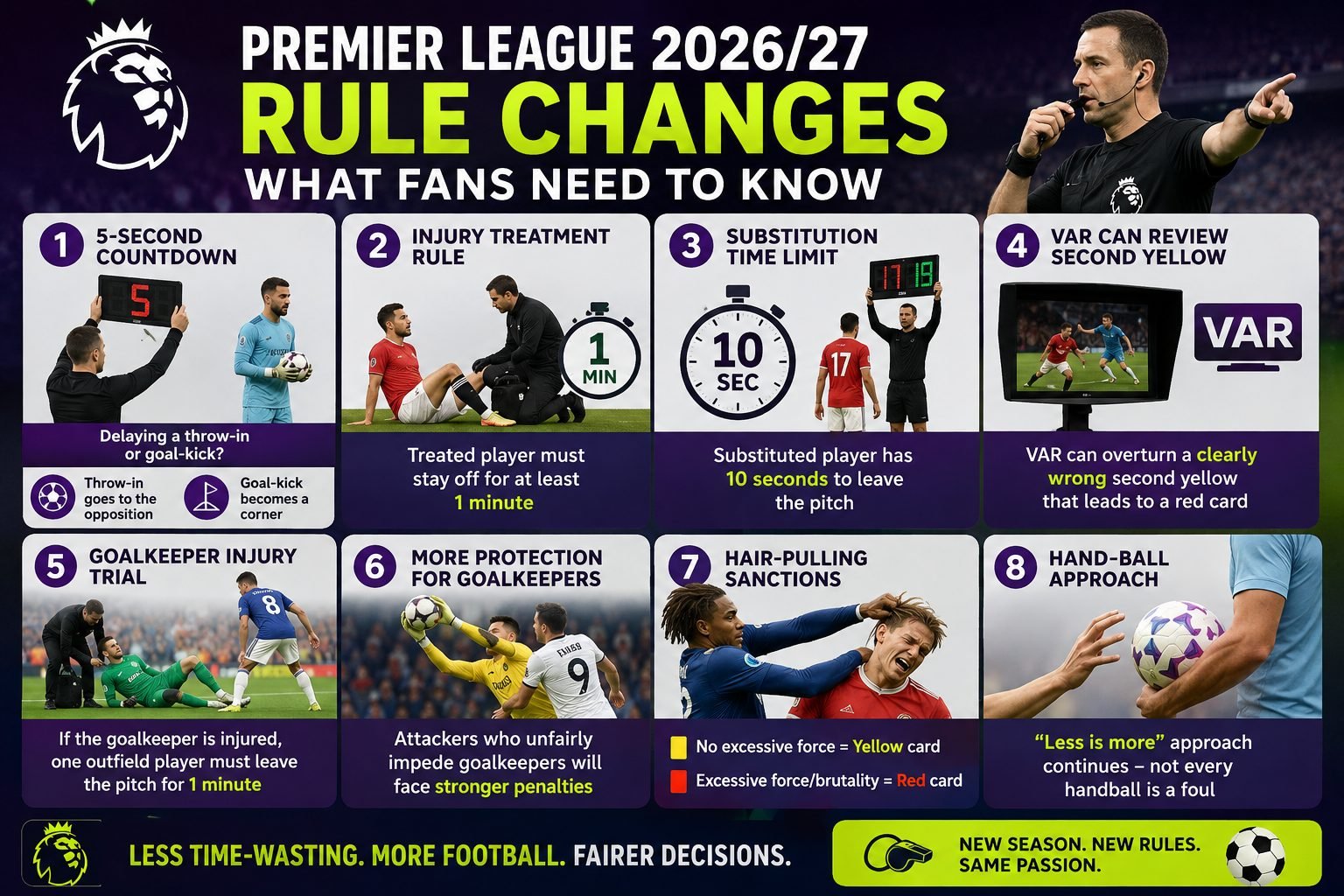
Imagine a goalkeeper going down injured just as his team is trying to protect a lead, the physio jogs on, play stops for a minute or two, and by the time the game restarts, the opposing attack has lost whatever momentum it had. That scenario, familiar to any regular Premier League viewer, is exactly what the league’s new trial rule is designed to discourage this season. When play stops for a goalkeeper injury, the manager will now have to nominate an outfield player to leave the pitch, and that player must stay off for at least a minute once the game resumes, turning a potential time-wasting tactic into a real cost for the team using it.
That trial is one of five officiating changes arriving with the 2026/27 season, all aimed at the same broader target: reducing unnecessary stoppages and closing the loopholes teams have historically used to slow games down.
The treatment rule for outfield players has been tightened as well. Anyone receiving on-field treatment after a stoppage now has to stay off for a full minute once play restarts, up from the previous 30-second threshold, discouraging players from returning immediately once the game resumes in their team’s favor.
Set-piece delays are getting a harder deadline too. Referees can now impose a five-second countdown on throw-ins or goal-kicks when a team is visibly stalling. Miss that window on a throw-in, and possession flips to the opposition. Miss it on a goal-kick, and the other team gets a corner, a real consequence rather than just a verbal warning from officials.
Substitutions come with their own new clock. Players being subbed off are expected to leave the pitch within 10 seconds of the change being signaled. Dawdle without good reason, and the incoming substitute has to wait until the next stoppage after a full minute has passed, effectively punishing the team for the delay rather than rewarding it.
VAR’s role has also expanded, though only modestly. Officials can now step in when a player receives a clearly wrong second yellow card that results in a sending-off. It’s a narrow addition, not a broader mandate to review every borderline card decision, but it closes off one of the more consequential kinds of officiating error.
Taken together, the changes reflect a league trying to close off the small, familiar ways games get stretched out and slowed down. Players, coaches, and referees will all need time to adjust to the tighter enforcement, but the intent is clear.