


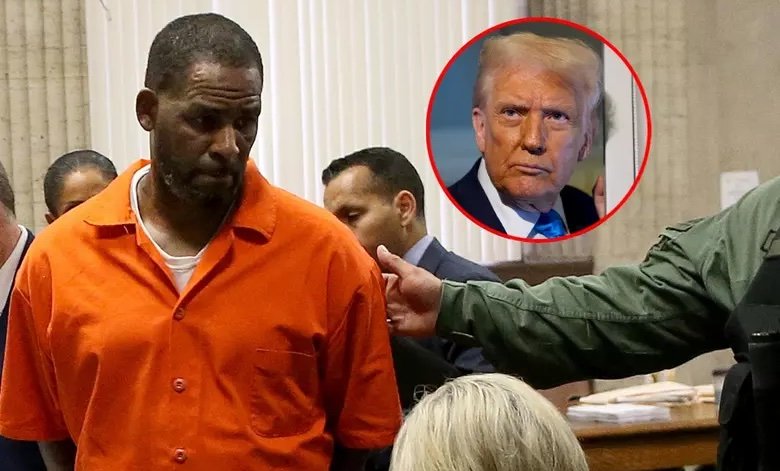
Disgraced R&B singer R. Kelly has turned to one of the few avenues still available to him, formally asking United States President Donald Trump to reduce the prison sentence that is expected to keep him behind bars for decades.
According to records from the Office of the Pardon Attorney, Kelly, whose legal name is Robert Sylvester Kelly, has submitted a request for executive clemency to the US Department of Justice. The application does not seek to erase his convictions through a pardon but instead asks for a commutation, a form of presidential intervention that reduces a sentence while leaving the underlying guilty verdict intact.
The request underscores the difficult legal position facing the singer, whose downfall marked one of the most significant reckonings of the #MeToo era. Once one of the most successful figures in contemporary R&B, Kelly is now serving a 31-year sentence following convictions in multiple federal cases involving sexual abuse and exploitation.
His most high-profile conviction came in 2021, when prosecutors successfully argued that the singer had used his celebrity status and inner circle to operate what amounted to a criminal enterprise. A federal jury found him guilty of racketeering charges linked to the recruitment and abuse of women and underage girls, resulting in a 30-year prison sentence.
The following year, Kelly was convicted in a separate federal trial on charges related to child sexual abuse material and child enticement. Although he received an additional 20-year sentence, much of that punishment was ordered to run concurrently with his earlier term, extending his total prison time to 31 years.
Now 59, Kelly is being held in a federal correctional facility in North Carolina and is not expected to be released until January 2046. With most legal appeals exhausted, the clemency process represents one of the last mechanisms that could alter the timeline of his incarceration.
However, obtaining presidential clemency is far from straightforward. Commutations are relatively rare and often involve a combination of legal, humanitarian and political considerations. In Kelly’s case, the severity of the charges and the public attention surrounding his convictions may complicate any effort to secure relief.
His legal team has spent more than a year attempting to persuade Trump to intervene. Attorney Beau Brindley previously sought to have the singer transferred to home detention, alleging that Kelly faced threats to his safety from prison officials and fellow inmates. That request was ultimately rejected by the courts.
Despite the convictions, Kelly has consistently maintained his innocence and continues to deny the allegations against him.
Whether his appeal gains traction remains uncertain, but the filing highlights a broader reality of the American justice system: for some high-profile inmates, presidential clemency can become the final hope after traditional legal options have run their course.