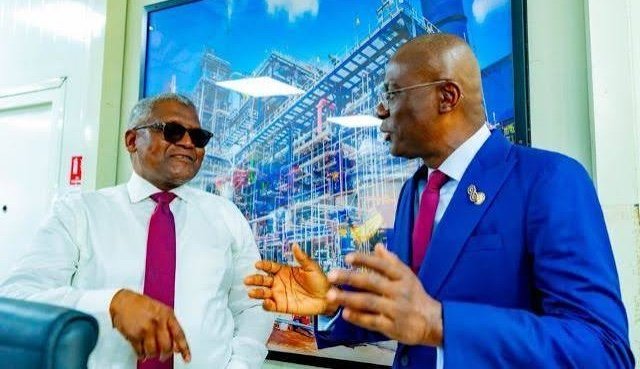
Governor Babajide Sanwo-Olu of Lagos State has described the Dangote Refinery as more than merely an industrial project, asserting that its construction showcased Africa’s ability to execute ambitious projects on a market-changing scale.
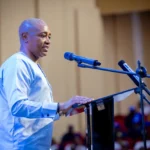
Sanwo-Olu spoke yesterday at the official launch of the Africa–Diaspora Leadership Programme 2026 Young Global Leaders Convening, tagged “Building Africa at Scale,” held at the Dangote Refinery and Petrochemical Complex in Ibeju-Lekki, Lagos.
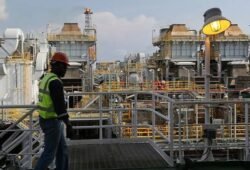
The governor disclosed that the refinery was built on land reclaimed from swamp, lagoon, and open water, while additional infrastructure, including a jetty and power plant, had to be developed to support the project.
He cautioned, however, that Africa’s development should not rely on individual “heroism,” emphasising that the true measure of the refinery’s success is whether the next major industrial project becomes easier to build.
Sanwo-Olu highlighted the Lekki Deep Sea Port, Lekki Free Zone, and Lagos Blue Line rail as part of his administration’s efforts to create infrastructure that would lessen the barriers for future investors and developers.
The governor also called for increased participation of African pension funds, sovereign wealth funds, and the diaspora in owning strategic assets across the continent. He stated that Africa’s next growth phase requires collective ownership and collaboration.
He said: “Mr. Dangote did not build a refinery. He built a country around a refinery, and then he built the refinery. There was no port capable of receiving the equipment, so he built a jetty.
“There was not enough power, so he built a power plant. The plant was late; it cost far more than anyone had planned. It endured a pandemic, a currency that lost much of its value, and more than one season in which serious people whispered — quietly, and sometimes not so quietly — that it would never run.
“It runs. That is the first thing to note: Africa can build on a market-changing scale. Not in theory. The thing dismissed as unrealistic is the very thing you are standing inside.
“Scale that depends on one man building his own port and his own power plant is not real scale. It is heroism. And heroism does not repeat. You cannot ask a pension fund to underwrite it. If Africa must wait for a builder of Aliko Dangote’s stubbornness every time it needs a refinery or a railway, then we will build one of everything, and we will build it once.”
Sanwo-Olu urged the Young Global Leaders to move beyond discussions and turn connections made during the gathering into practical projects that address real problems, insisting that Africa does not need the world’s permission to build.
He said: “In eleven days, you will gather at 1280 Fifth Avenue, on the edge of Harlem, overlooking Central Park. When you get there, notice something. You will be standing in an island city built on water by people who arrived from somewhere else with nothing but ambition — and you will have just left another one.
“Lagos and New York are not strangers. They are the same argument in two accents: that a city can be made from the sheer determination of people who refused to wait for conditions to be perfect. Carry that with you.
“Carry the numbers, yes, but carry the harder lesson too: that Africa does not need the world’s permission to build, and that the world, if it comes as a partner and not a prospector, will find that Africa has already started.”
At the event, Dangote said the philosophy behind the IPO was to extend the prosperity created by the refinery beyond its promoters and give ordinary Africans an opportunity to become owners, a statement by Dangote Group quoted him as saying.
“I want drivers, cooks, the women selling food on the streets of Ghana, Rwanda and South Africa to invest so they can share in this prosperity,” Dangote said during a fireside chat. “We are doing the IPO to pass this prosperity to Africans,” he explained.
Dangote said his ambition had always gone beyond accumulating wealth to building enterprises capable of creating jobs, opportunities and prosperity across the continent.
“I am wealthy, not rich. A wealthy man creates wealth, while a rich man makes money and keeps it for himself,” he said. “What keeps me going is that we must industrialise Africa. There is no amount of hurdles that will stop us. If you put a brick wall in front of me, I will make a hole and pass through.”
He expressed confidence that the refinery could eventually become Africa’s largest company by size and profitability, drawing parallels with global corporations such as Amazon, Microsoft, Tesla and Alibaba, which grew substantially after entering the public markets.
“By the grace of God, this refinery will be the largest company in Africa by size and profitability,” he said.
He said the group’s wider mission was to reduce the perceived risks associated with investing in Africa and demonstrate that globally competitive enterprises could be built successfully on the continent. “Our job is to derisk Africa, encourage more investors, create jobs and create more opportunities. That is how we will transform Africa,” Dangote said.
Speaking, former United States Assistant Secretary of State for African Affairs and Co-Chair of the Africa Center, Ambassador Jendayi Frazer, said the proposed IPO could connect African industrial production with African and diaspora capital, broadening participation in the value created by the continent’s strategic assets.
“The refinery connects us all through the proposed IPO that creates broader ownership,” Frazer said. “It can broaden participation in the value created by African industry. It can connect investment with African production to scale with African institutions, pension funds, savers, individual investors, including the African diaspora coming into this, owning a stake in Africa’s growth.”
Frazer said the refinery had already “changed the equation” for Africa, with implications extending far beyond petroleum production into the continent’s geopolitical standing.
“Economic power is not only what a country possesses, it’s what it can create, process, finance, transport and sell. Supply chains, energy systems and capital markets shape sovereignty,” she said.
She said the refinery demonstrated what was possible when African ambition was matched by capital, technical knowledge, partnerships and disciplined execution.
Group Executive Director, Commercial Operations, Dangote Industries Limited, Fatima Aliko-Dangote, said Africa must now move beyond merely possessing natural resources and talent to building the productive capacity and institutions required to retain the value they create.
She said the deeper question was what Africa could build, process, finance and own, arguing that development must ultimately translate into tangible improvements in people’s lives.
“This is more than a Dangote story. It is a story about what Africa must build, what Africa must own, and what this generation of leaders must help make possible,” she said.
A Trustee of the Aliko Dangote Foundation, The Africa Centre in New York and Patron of the Aliko Dangote Young Global Leaders Fellowship, she said that sustainable development must ultimately be measured by its impact on people.
Similarly, the African Export-Import Bank (Afreximbank), which provided significant financial backing for the refinery, described the project as its African industrialisation mission “made concrete”.
Speaking on behalf of the President and Chairman of the Board of Directors of Afreximbank, Director, Creatives and Diaspora, Intra African Trade and Export Development Bank, Temwa Roosevelt Gondwe, said Afreximbank underwrote $2.5 billion of the $4 billion syndicated loan supporting the refinery and subsequently provided a $1 billion working capital facility.
“Unless we produce, we cannot trade. Unless we capture value, we cannot prosper,” Gondwe said, describing the refinery as proof that Africa could move from exporting raw materials towards processing resources and capturing more value on the continent.
The convening also highlighted the Aliko Dangote Foundation’s investment in Africa’s leadership pipeline.
Also yesterday, Dangote, emphasised that the planned public offering of shares in Dangote Petroleum Refinery was not merely a capital-raising exercise but an opportunity to broaden Nigerians’ participation in one of Africa’s most ambitious industrial investments.