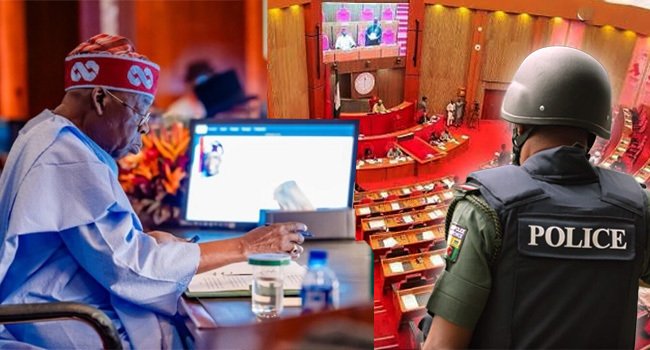
Nigeria’s decades-long debate over the creation of State Police has entered a critical stage following the transmission of theConstitution (Sixth Alteration) Bill, 2026, to the 36 State Houses of Assembly for consideration and approval.
The development marks a significant step in the ongoing constitutional amendment process and could determine the future structure of policing and internal security management across the country. For the proposal to become law, at least 24 of the 36 state legislatures must approve the amendment in line with constitutional requirements.
The proposed legislation seeks to introduce a multi-level policing framework that would allow state governments to establish and manage their own police services while preserving the Nigeria Police Force as the federal law enforcement agency responsible for national security matters and inter-state crimes.
The renewed push for State Police comes against the backdrop of persistent security challenges, including banditry, kidnapping, terrorism, communal clashes and other forms of violent crime that have placed increasing pressure on the country’s centralised policing system.
Supporters of the proposal argue that a decentralised policing structure would improve intelligence gathering, enhance community engagement and enable faster responses to local security threats. They contend that officers recruited from and deployed within their communities are more likely to understand local languages, cultures and security dynamics.
However, the proposal continues to generate debate among security professionals, policymakers and civil society groups.
Director-General of the Institute for Police and Security Policy Research, Dr Charles Omole, warned that simply creating State Police formations without addressing deeper institutional challenges could create new problems. According to him, the focus should not be limited to decentralisation but should also include reforms aimed at improving professionalism, accountability and operational standards.
Omole noted that concerns remain over the possibility of political interference and abuse of power by state authorities. He stressed the need for robust safeguards, transparent recruitment processes and independent oversight mechanisms to prevent the misuse of security agencies for political purposes.
He also argued that any successful State Police system must avoid replicating weaknesses that critics have identified within the existing policing framework.
On the other hand, Chairman of the Nigeria Police Committee on the Establishment of State Police, Prof. Olu Ogunsakin, expressed confidence that the proposal would receive broad support across the federation. He dismissed claims that senior police officers overwhelmingly oppose the initiative and pointed to ongoing consultations involving the Inspector-General of Police and other stakeholders.
According to him, continued engagement is expected to address concerns and build consensus around the proposed reforms. A stakeholders’ retreat scheduled in Owerri is expected to further examine key issues surrounding implementation and operational structure.
Meanwhile, the Conference of Speakers of State Legislatures has indicated that state assemblies are awaiting the official documents before commencing formal deliberations. The body, led by Delta State House of Assembly Speaker Emomotimi Guwor, also plans consultations with the Nigeria Governors’ Forum to facilitate discussions and harmonise positions on the proposal.
The debates expected across the states are likely to focus on funding arrangements, command structures, oversight mechanisms, recruitment standards and the relationship between state and federal security institutions.
The decisions taken by the state assemblies in the coming weeks could have far-reaching implications for Nigeria’s security architecture. If approved by the required number of states, the amendment would represent one of the most significant changes to the country’s policing system since independence.
As lawmakers begin deliberations, the future of State Police now rests largely in the hands of the 36 state legislatures, whose votes will determine whether Nigeria adopts a decentralised policing model or maintains its current centralised structure.