


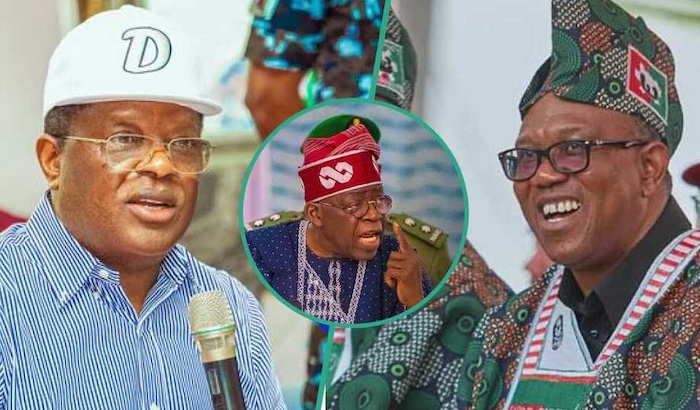
Minister of Works David Umahi has defended President Bola Tinubu’s administration, arguing that the government’s ongoing reforms are beginning to deliver results while dismissing suggestions that Labour Party leader Peter Obi poses any political challenge to the ruling All Progressives Congress (APC).
Speaking during a television interview on Tuesday, Umahi said President Tinubu inherited deep-rooted economic problems that could not be resolved within a few years. He likened the country’s recovery process to the healing of a wound, stressing that meaningful economic transformation requires patience.
“The darkest part of the night is the dawn,” he said, adding that decades of accumulated policy failures could not realistically be corrected within three years. According to the minister, critics expecting immediate results were overlooking the scale of the challenges inherited by the current administration.
Umahi maintained that Tinubu’s reforms were already yielding positive outcomes and insisted the president deserved another term in office. He argued that opposition figures lacked comparable ideas or the capacity to implement similar reforms, claiming many of the government’s critics were motivated more by political ambition than by better policy alternatives.
The minister also rejected claims that the APC was concerned about Peter Obi’s growing political influence. Describing the support surrounding the former Anambra State governor as “AI politics,” Umahi said it created an exaggerated perception of Obi’s popularity without reflecting political reality.
He further claimed that Obi was not a threat to either Tinubu or the APC, insisting that even he personally had no reason to fear the former presidential candidate.
Umahi went on to question Obi’s performance during his tenure as governor of Anambra State. He criticised the former governor over what he described as shortcomings in infrastructure, industrial development, and public empowerment, arguing that Obi lacked the moral authority to demand Tinubu’s resignation over current national challenges.
Reacting to reports that Obi had called on the president to step down, Umahi asked why Obi himself never resigned over what he characterised as failures during his own administration, including poor road infrastructure, limited industrial growth, and delayed payments to contractors.
The minister also criticised the Obidient movement, accusing some of its supporters of responding to opposing views with insults, threats and hostility. He contrasted this with Tinubu’s approach, questioning why the president had not pursued legal action despite repeated criticism from political opponents.
Umahi concluded by challenging members of the Obidient movement to engage him in a debate on infrastructure projects and the Tinubu administration’s reforms, insisting that no opposition candidate could match the government’s record on national development.