

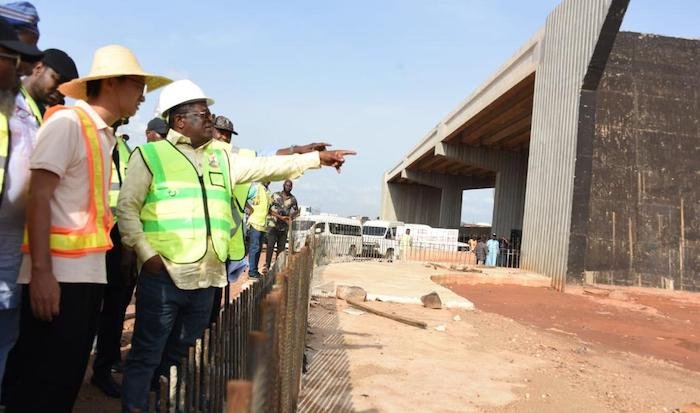
Minister of Works, Senator David Umahi, has ordered the arrest of the Managing Director of Hartland Nigeria Ltd and directed officials to recover funds paid to the company over an 11-kilometre road project in Delta State.
Umahi issued the orders on Wednesday during an inspection of the Agbor-Asaba-Onitsha road corridor, where he accused the contractor of failing to deliver on an agreement despite receiving about N14 billion.
The minister said Hartland had completed only about 40 per cent of the project, which covers the stretch from Summit Junction to the head bridge, as well as channelisation and hydraulic structures. He said the company had been expected to deliver the entire project with the funds already released.
“When I paid them that money, we reached an agreement: they were to finish 11 kilometres from Summit Junction to this head bridge with that money, as well as handle the channelisation and hydraulic structures,” Umahi said.
Frustrated by the contractor’s performance, the minister directed the ministry’s Controller to locate and arrest the managing director.
“I’ve called the MD to discuss their return to the site. I am going to look for him and have him arrested. I’m going to arrest him,” he declared.
Umahi also ordered the ministry to activate the Advance Payment Guarantee and contact the relevant banks to begin recovering the money paid to Hartland.
Beyond the immediate recovery effort, he ordered a comprehensive audit of the contractor’s payment records and certificates across all its projects, warning that the company would be sanctioned if found to have breached its obligations.The minister also demanded immediate action on the unfinished road, directing officials to fill both sides of the head bridge approach by the following morning.
“Look at the kind of mess we are dealing with! Failing to do even simple filling on the road is pure wickedness,” he said.
The inspection also exposed another challenge facing the ministry: vandalism of the Second Niger Bridge. According to Umahi, vandals had removed bolts, steel members and expansion joints from the bridge, raising concerns about the safety of the critical infrastructure. He warned that continued damage could have serious consequences if the affected components were not urgently restored.
“The Ministry does not have an emergency fund to attend to this, and if this is not attended to, it can result in a catastrophic situation,” he said.
Umahi subsequently directed the immediate repair of the damaged sections and ordered tighter security around the bridge. He also approved the installation of solar-powered lighting and CCTV cameras, with designated ministry officials and security agencies expected to have access to the surveillance feeds.
The minister further inspected erosion around the Second Niger Bridge and ordered remedial work to commence immediately.
The directives underline the ministry’s renewed focus on enforcing contractor obligations while protecting major transport infrastructure from vandalism and deterioration.