

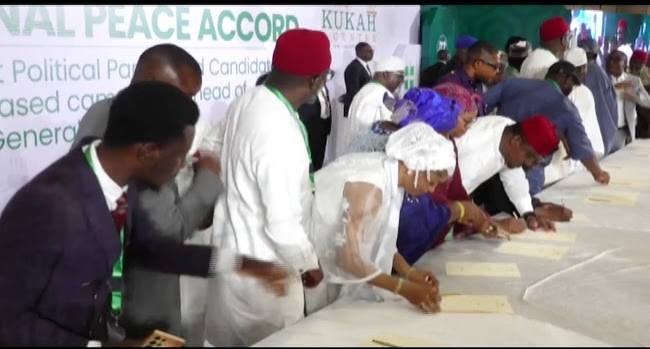
Presidential candidates and political party leaders have signed a National Peace Accord ahead of the 2027 general elections, pledging to pursue issue-based campaigns and reject violence, hate speech, fake news and ethnic or religious incitement.
However, the absence of some leading candidates was one of the major developments at the ceremony in Abuja on Tuesday. President Bola Tinubu, the All Progressives Congress candidate, and African Democratic Congress candidate Atiku Abubakar were among those who did not personally attend. Tinubu was represented by the Secretary to the Government of the Federation, Senator George Akume.
The agreement was organised by the National Peace Committee in partnership with The Kukah Centre ahead of the commencement of election campaigns on Wednesday.
Among the candidates present were Peter Obi of the Nigeria Democratic Congress, Adewole Adebayo of the Social Democratic Party and Omoyele Sowore of the African Action Congress.
The accord commits political actors, their campaign teams and supporters to peaceful competition and responsible conduct throughout the election period. Organisers said the agreement was backed by existing electoral and constitutional laws and should not be regarded as merely a ceremonial exercise.
Speaking at the event, Obi called on Nigerians to punish politicians who violate the agreement by refusing to vote for them. He also appealed for credible elections in which votes would count and said no Nigerian should lose his or her life because of political contests.
The National Peace Committee also raised concerns about the political climate ahead of the polls. Its Project Manager at The Kukah Centre, Asabe Ndaye, said monitoring of the 2023 electoral cycle showed that violations relating to issue-based campaigns accounted for 43 per cent of recorded breaches, while violations involving insults and violence stood at 13.5 per cent.
She further disclosed that the committee’s Election Security Information Hub recorded 2,510 security incidents between June 2025 and August 2026, alongside 381 electoral offences. Vote-buying, political violence, intimidation, misinformation and voter suppression were identified among the major threats.
INEC Chairman, Prof. Joash Amupitan, said campaigns should focus on policies and solutions rather than character assassination and identity-based provocation. He described elections as “competitive job interviews before the electorate” and announced that presidential and National Assembly elections would hold on January 16, 2027, while governorship and House of Assembly polls would follow on February 6.
While the accord received broad support, Adebayo questioned its effectiveness, arguing that previous agreements had been violated without consequences. The National Peace Committee, however, said the initiative was intended to establish clear boundaries for peaceful political competition as the 2027 campaign season begins.