

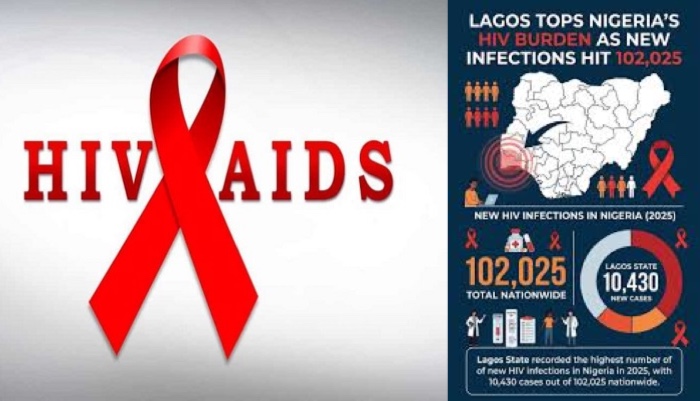
Nigeria recorded 102,025 new HIV infections across its 36 states and the Federal Capital Territory in 2025, with Lagos State bearing the heaviest burden at 10,430 new cases, according to the Federal Ministry of Health and Social Welfare’s State of the Health of the Nation Report 2025.
A state-by-state breakdown shows the epidemic remains heavily concentrated in a handful of states. Rivers State recorded the second-highest figure at 6,287 new infections, followed by Kano with 6,106. Akwa Ibom reported 5,413 cases, Taraba 4,854, Benue 4,804, and Anambra 4,468. Kaduna registered 3,659 new infections, while Adamawa and the FCT recorded 2,989 and 2,764 respectively, rounding out the ten states with the highest infection counts for the year.
A further tier of states each recorded more than 2,000 new infections, including Cross River, Sokoto, Abia, Imo, Delta, Borno, Ogun, Plateau, Niger, and Ebonyi. At the lower end, Ekiti recorded the fewest new infections nationally at 462, followed by Bayelsa with 982 and Gombe with 1,083.
The figures highlight that HIV remains a major public health challenge in Nigeria, even after years of expanded treatment access and falling AIDS-related mortality. The country operates one of the largest HIV treatment programmes in the world, with millions of people living with the virus accessing antiretroviral therapy through government and donor-funded facilities. Public health experts note, however, that curbing new infections remains particularly difficult among adolescent girls, young women, infants exposed to HIV, and other high-risk groups.
Through the National Agency for the Control of AIDS (NACA), the Federal Government has expanded free HIV testing, scaled up programmes to prevent mother-to-child transmission, and promoted pre-exposure prophylaxis for high-risk populations, alongside stronger community awareness campaigns and digital surveillance systems. Nigeria has adopted the global 95-95-95 targets, which aim to ensure that 95 percent of people living with HIV know their status, 95 percent of those diagnosed are on sustained treatment, and 95 percent of those on treatment achieve viral suppression by 2030.
UNAIDS Executive Director Winnie Byanyima has cautioned that global progress against HIV remains fragile despite notable gains, noting that around 1.3 million people were newly infected worldwide in 2024. NACA Director-General Dr Temitope Ilori has echoed similar concerns domestically, repeatedly calling for stronger domestic financing and community-led interventions to sustain Nigeria’s HIV response, particularly as declining international donor support threatens to undermine years of progress.