

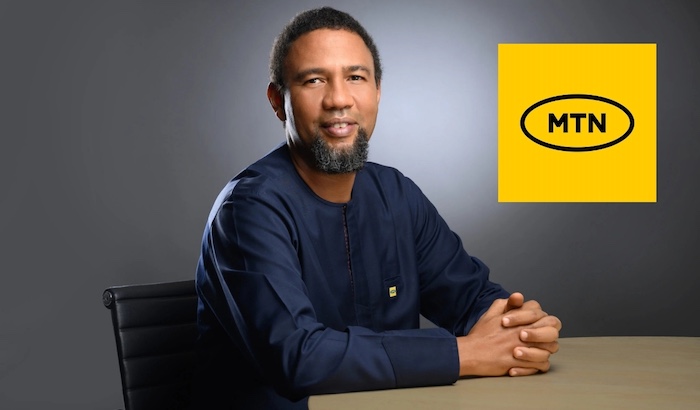
MTN Nigeria Chief Executive Officer Karl Toriola has pushed back against the perception that the telecom giant is a foreign-owned company, arguing that MTN is deeply woven into Nigeria’s economy and ownership structure, even as he defended the recent tariff increase that has drawn public criticism.
Speaking on Arise News, Toriola rejected the label of MTN as simply a South African company, noting that while MTN Group was founded in South Africa, its shareholding is now globally dispersed. “We are labelled as a South African company because MTN Group was founded in South Africa. But the reality is that MTN Group has a very diverse global shareholding. Only about 50 percent of the shareholding is African, while the rest is held by investors from North America, Europe, the United Kingdom, the Middle East and Asia-Pacific,” he said.
He drew a sharper distinction when speaking specifically about the Nigerian subsidiary. “MTN Nigeria is a Nigerian company through and through. We are domiciled in Nigeria. We are listed on the Nigerian Exchange. We pay all the taxes, duties and levies expected of us, and we are run by Nigerians,” Toriola said, adding that every member of the executive committee except one is Nigerian, and that the entire expatriate workforce in the country numbers just four people. He pointed to broad-based Nigerian ownership as further evidence, citing over 201,000 retail investors and roughly 11 million Nigerians who hold MTN shares indirectly through pension funds.
Turning to the controversial tariff adjustment, Toriola framed it as a survival measure rather than a profit grab. “People perceived the tariff increase as an aspiration for profitability, but the reality was that we were on our knees financially. We couldn’t even pay our month-to-month bills with the revenues we were generating. The tariff adjustment was an absolute necessity. It enabled us to stay alive,” he said.
He credited the resulting revenue improvement with enabling a sharp jump in capital investment, from roughly ₦250 billion budgeted in 2024 to about ₦1 trillion in 2025. He noted that in the first quarter of this year alone, MTN spent ₦390 billion on capital expenditure, compared with a profit after tax of ₦359 billion over the same period, a gap he presented as proof the company is reinvesting rather than simply pocketing higher margins.
On persistent complaints about poor network quality, Toriola attributed the problem to a mix of factors beyond MTN’s direct control, including rising customer demand, infrastructure gaps, vandalism, insecurity and unreliable electricity. He described deliberate attacks on infrastructure, including people setting manholes on fire, and cited the operational burden of running roughly 18,000 sites nationwide, each dependent on generators, batteries and constant fuelling due to weak public power supply. “We are not perfect, but we are investing aggressively and continuously striving to do better,” he said.
Addressing allegations that operators deliberately drain customer data, Toriola said MTN’s investigations repeatedly trace excessive consumption back to background activity on users’ own devices, such as automatic cloud backups from apps like iCloud and WhatsApp. He advised customers to review their device settings and use Wi-Fi rather than mobile data for routine backups.