


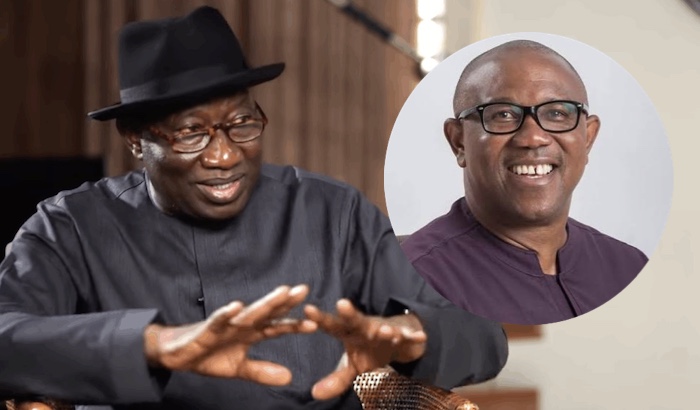
Former President Goodluck Jonathan has denied a media report claiming he was offered ₦500 billion to run against National Democratic Congress presidential candidate Peter Obi in a bid to split South-South votes.
Jonathan’s Special Adviser on Media, Dr Ikechukwu Eze, described the report as entirely false and baseless in a statement issued Sunday in Abuja. He said the story, published by what he called a little-known website, falsely attributed the ₦500 billion claim to Jonathan without providing basic supporting detail. “The report failed to state where or when Jonathan allegedly made such a claim, who was present or who purportedly made the alleged offer,” he said.
Eze said the publication carried all the markers of deliberately fabricated news designed to mislead the public and draw the former president into unwarranted political controversy.
The claim taps into a familiar undercurrent in Nigerian political speculation, the idea that a South-South heavyweight like Jonathan could be persuaded to enter a presidential race specifically to dilute support for another candidate from the same region. Obi, who has built a substantial following partly on the strength of his appeal across the South-South and South-East, would be a natural target for that kind of strategy in the eyes of his rivals, which is likely part of why a report alleging this kind of vote-splitting arrangement gained enough traction to warrant a formal denial. Jonathan himself, as a former president and one of the most recognisable political figures to emerge from the South-South, remains a name frequently invoked in speculation about regional political strategy, even when, as in this case, there is no substantiated link to the claims being made.
Eze acknowledged that this kind of story tends to proliferate as election season approaches, when unverified claims and fabricated attributions circulate more freely and can shape public perception before they are checked. He urged Nigerians to disregard the report entirely and to verify sensational claims through credible sources before sharing them, a caution he framed as necessary given how quickly political misinformation can spread once it gains initial traction online.